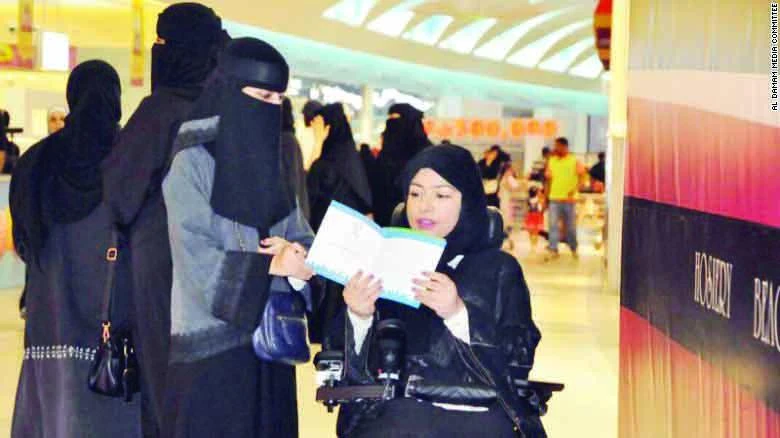
RIYADH: Difficult terms and conditions as well as the complicated process have disappointed many women who aspired to contest the third municipal council elections.
This resulted in limiting the number of women candidates to just 979 against 5,938 men running for positions, according to an online newspaper.
The newspaper said that many women withdrew their names before the announcement of candidates due to social and administrative reasons which hindered their march toward the final stage in the contest for municipal council seats.
The primary reasons were the lack of financial support and difficult terms and conditions, in addition to the social perspective and tribal loyalties.
Norah Al-Soyan, founding member of the "Baladi Initiative" and training supervisor of elections in the Riyadh region, said that many women withdrew from the elections due to social and financial issues, and administrative reasons.
Many women realized running a campaign is not an easy task in a society which doubts women's leadership capabilities.
Many women did not have sufficient financial support to run electoral campaigns because their income level is less than that of men.
She said that women still face social pressure when it comes to entering a new area, which is still seen as an embarrassment by tribes.
The social awareness campaign launched for the purpose was not strong enough to change minds.
As far as the election process is concerned, the Baladi Initiative tried to educate them.
But may women withdrew from the contest due to the lack of knowledge about the election process.
Haifa Al-Bikr, one of the candidates who withdrew from the fray, blamed difficult terms and conditions for the change of mind of many
women who aspired to run and had shown initial interest. She said the use of social media was barred as a tool for announcements or advertisement of a candidature.
“Contrary to men, women have less financial support. I, as a candidate, spent lots of money on my election campaign from my personal account.
It was a clear loss compared to men who get support and sponsorship of companies and institutions, tribes and families.”
Women were not allowed to speak in front of men to announce their electoral platforms. They were just allowed to seek help of a Mahram, or pay a person to speak on her behalf, she said.
Haifa described the participation of women as candidates in the elections as less than aspired, and many lacked strategic planning due social conditions.
It was difficult for them to break traditional social barriers.
Women find odds heavily stacked against them