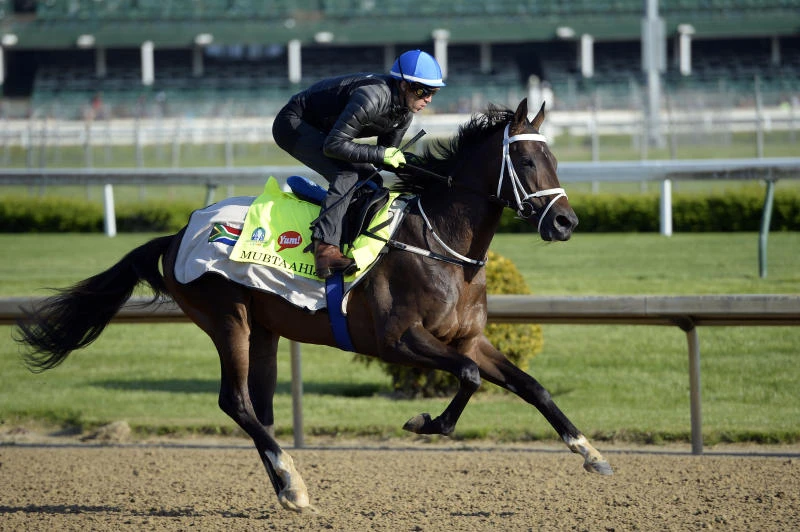
LOUISVILLE, Kentucky: Mubtaahij poked his gorgeous head out of his roomy stall and cocked it leftward, where his dichromatic vision left him underserved. Close by, but far enough away that he couldn’t try to eat it, hung a national flag with the six-color pattern that reflects the complex history of South Africa.
Out on the grass stood Mike de Kock, a world-renowned South African trainer debuting at the Kentucky Derby and saying of the Ireland-bred, Dubai-feted Mubtaahij: “He’s gotten more relaxed since he’s been here. You can see he’s hardly raised a sweat at all.” At the other end of Barn 42 worked Kiaran McLaughlin, who hails from Lexington, Kentucky, but trains Frosted for Sheikh Mohammed bin Rashid Al Maktoum, the horseman who works also as vice president of the United Arab Emirates.
Way over at Barn 33, the usual crowds had hovered around favored American Pharoah, thus around his owner, Ahmed Zayat, born in Cairo, resident of New Jersey and the world. And they had cooed all week over Pharoah’s colossal stablemate, Dortmund, whose owner, Kaleem Shah, hails from India and resides in Vienna, the one in Virginia.
Kentucky Derbies always carry at least a dose of internationalism, often in the jockeys’ room alone, which this year will mesh contestants from Belgium, the Dominican Republic, France, Ireland, Mexico, Peru, Venezuela and Panama, not to omit Puerto Rico. The dose has some pop this time, with Mubtaahij lending some intrigue even if his jet-setting figures to hinder him, and lending the sight of a few “Mubtaahij” caps, with the flags of UAE on one side (ownership) and South Africa on the other (trainer-ship).
“You know, I just always view other sports and try and compare them with racing,” de Kock said. “I mean, what would the Masters be without players from all over the world? I think it’s something racing needs to encourage more.
“The East gets it right. You know, you take places like Hong Kong, Dubai, and England to an extent as well, with the international races. I think it does add something to the meeting. I can just see with us being here, there’s been something else for people to divert their attention to, instead of same-old, same-old. Something new, something intriguing, whether it comes off or not, it doesn’t matter.
“The fact is that, I think, anybody involved in any sport needs to internationalize and test their athletes against athletes from the rest of the world. Otherwise, what’s it about?“
Baseball teams, he notes even as a novice, don’t restrict their contests to their own states.
Even with his peripatetic success, de Kock had visited Churchill Downs only for the 2000 Breeders Cup, where his lasting memory involves a Pick Six that withered agonizingly in the Classic when Giant’s Causeway bowed to Tiznow. From afar he has studied how Triple Crown trainers navigate the spring grind. Up close, he extols Churchill Downs’ hospitality.
“Entries, declarations, all that type of thing, licensing, they make it simple,” he said. “They make it happen. Whereas try and get a license in England, it’s like I’m about to invade the place!“
With the vagaries between Southern Hemisphere breeding and Northern Hemisphere breeding — and their implications for horse ages — de Kock expected to attend a Derby maybe only as a spectator someday. Now that he has some Northern Hemisphere horses, such as Mubtaahij, he arrives as a surprised participant.
Down the barn, McLaughlin trains for an owner long since unsurprised to participate. The Kentucky Derby dreams of Frosted owner Sheikh Mohammed bin Rashid Al Maktoum, the cousin of Mubtaahij owner Sheikh Mohammed bin Khalifa Al Maktoum, stretch well back into last century. They stretch so long that, back in 2001, he had experienced enough frustration to tell writer Claire Novak in France, “The Kentucky Derby is a more difficult race to win than I first believed.”
He began with Arazi, the superstar favorite in 1992 because of an eye-popping rout of Breeders Cup Juvenile opponents at Churchill Downs on Nov. 2, 1991. Through Derby week 1992, multitudes followed Arazi from barn to track and back to barn as if spellbound. When Arazi ran a perfunctory eighth, it marked a fitting outset to Sheikh Mohammed bin Rashid Al Maktoum’s Derby plight.
Twenty-three years on, he has buttressed the global industry, built an Oz of a track in the Dubai sands, birthed the world’s richest race (the Dubai World Cup) and weathered an intra-operation doping scandal. All the while, China Visit’s sixth-place finish at the 2000 Kentucky Derby has remained his best, and Frosted has come with a change of tack, prepping in the United States, winning the Wood Memorial and avoiding long equine flights, such as the one Arazi took after his prep race in France.
“It would take me a day to talk about Sheikh Mohammed and what he has done in the world of racing, and that’s what so special,” McLaughlin said. “I mean, probably no one, with 19 owners, and the other owners, and they deserve this win Saturday, but no one deserves it more than Sheikh Mohammed bin Rashid Al Maktoum. The passion and commitment to the thoroughbred industry, worldwide. If you look at all the sponsorships and his whole life, what he’s done for this business, it’s incredible.”
Noting the Derby’s difficulty, McLaughlin said, “It would be great to win the race, any shape or form, with those colors on for that man.”
With no horse from outside the country winning the Derby since Canonero II from nearby Venezuela in 1971, it would also be a fresh wrinkle in a shrinking world.
At Kentucky Derby, international flavor makes a world of difference