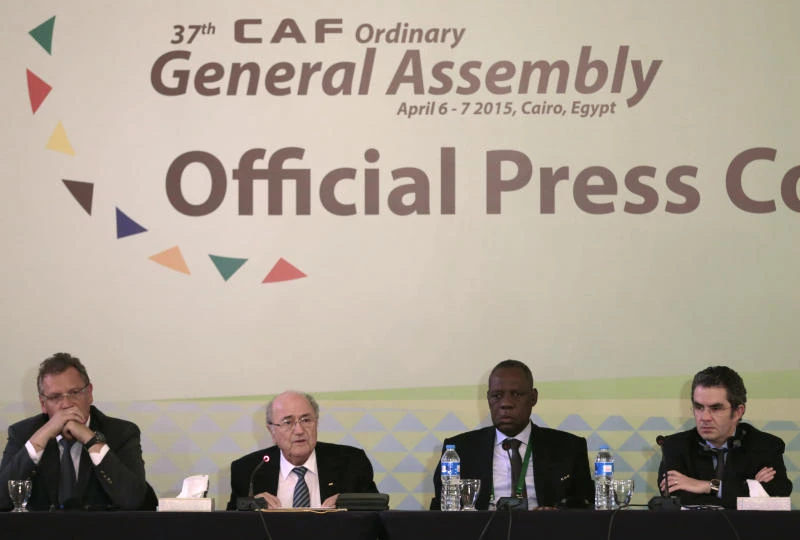
CAIRO: FIFA President Sepp Blatter on Tuesday expressed his opposition to a Palestinian bid to bar Israel from international competition, saying such a move would harm football’s governing body itself.
Blatter is due to meet Palestinian Football Association (PFA) chief Jibril Rajoub in Cairo later Tuesday to discuss PFA calls for Israel to be suspended by FIFA for its “racist behavior against Arabs.”
When asked at a press conference to comment on the PFA request, Blatter said that, “such a situation shall not occur at the FIFA congress because suspension of a federation for any reason is always something which harms the whole organization.”
“I will meet Jibril Rajoub, president of Palestine Football federation, later this afternoon. I can’t give you more details,” said the outgoing FIFA president who is seeking a fifth term in office at an election next month.
In its draft resolution asking Israel to be barred, the PFA also protested at the creation of “five clubs in settlements on land occupied since 1967, clubs participating in Israeli national championships in violation of international law.”
The PFA last called for Israel’s suspension in November after Israeli forces raided its headquarters in the West Bank city of Ramallah.
It has also cried foul over Israeli travel restrictions on Palestinian players.
To be passed the Palestinian resolution must win the support of at least 156 other delegates at the 209-member FIFA congress.
Blatter is attending a two-day meeting of the Confederation of African Football (CAF) in Cairo, which on Wednesday will choose a host country for the 2017 Africa Cup of Nations.
Africa promises support
Meanwhile, every one of Africa’s 54 member countries will vote for Blatter in next month’s FIFA presidential election, the continent’s soccer boss said on Tuesday, referring to the 79-year-old Swiss as “dear Sepp.”
In front of Blatter’s three challengers, Issa Hayatou, president of the Confederation of African Football, promised unanimous support in his speech to open CAF’s annual congress in Cairo.
African football leaders applauded his pledge in apparent agreement.
“Africa is comfortable having you. Africa stays with you,” Hayatou said to Blatter, according to a transcript of his comments provided by CAF.
Blatter was present in his role as FIFA president, and made a speech to the delegates, where he praised Hayatou as “a pillar” of African football, according to CAF.
“I’m a happy man,” Blatter said.
Africa is the largest of the six continental confederations and has 54 of the 209 FIFA member countries eligible to vote in the presidential election in Zurich on May 29.
Although the individual countries don’t have to follow Hayatou’s directive, the continent is expected to be a strong base of support for Blatter when he seeks a fifth term to extend a presidency that began in 1998.
FIFA vice president Prince Ali bin Al-Hussein of Jordan, Dutch FA head Michael van Praag, and former Portugal international Luis Figo are standing against him.
Hayatou, who has led CAF since 1988 and is senior FIFA vice president, also removed a hurdle to his own possible re-election as African football head when the congress voted to remove CAF’s age limits.
Like Blatter, the 68-year-old Hayatou said his current term would be his last, but also appears ready to go back on his promise and stand again in 2017. The rule changes removed restrictions on candidates who are 70 or older running for CAF office, and mean Hayatou could stand again in two years, and maybe take his reign beyond 30 years.
The changes were passed unanimously, CAF said.
CAF also elected two new members of FIFA’s executive committee: Tunisia’s Tarek Bouchamaoui and Congo’s Constant Omari Selemani. They will serve two-year terms, and not the normal four years because of another change to CAF’s statutes. From 2017, African places on FIFA’s ruling board will be decided by region, CAF said.
Jacques Anouma of Ivory Coast, who was prevented from standing against Hayatou in the last CAF presidential election, failed to keep his FIFA seat in Tuesday’s elections. Mohamed Raouraoua of Algeria, who is viewed as a possible future challenger to Hayatou, didn’t stand for re-election and also left FIFA’s executive committee.
Six members were re-elected to CAF’s executive committee, all of them unopposed.
Africa’s expected show of support for Blatter indicated that while the appetite for change at the top of world soccer is strong in Europe, it isn’t everywhere else.
The praise Blatter received in Egypt was in contrast to his uncomfortable reception at the UEFA congress in Austria last month, when his presidency was criticized by the three candidates standing against him, and some European officials.
Blatter’s three presidential challengers didn’t address CAF delegates like they did at UEFA’s congress and attended the CAF congress only as “observers,” CAF said.
Cameroon’s Hayatou, now an ally of Blatter after failing to unseat him as FIFA president in 2002, made an apparent reference to that UEFA congress.
“Dear Sepp,” Hayatou said. “I want to reiterate that here in Africa you are never on some strange or hostile territory. You shall always be at home here, on this continent.”
Blatter later gave an angry response to a reporter questioning his support of Hayatou, who has been the target of corruption allegations and was reprimanded by the IOC in 2011 for receiving money in a World Cup kickbacks scandal in the mid-1990s.
“This is an absolute disgusting declaration that you are doing here. I reject it,” Blatter told the reporter.
Blatter opposes Palestinian bid to bar Israel