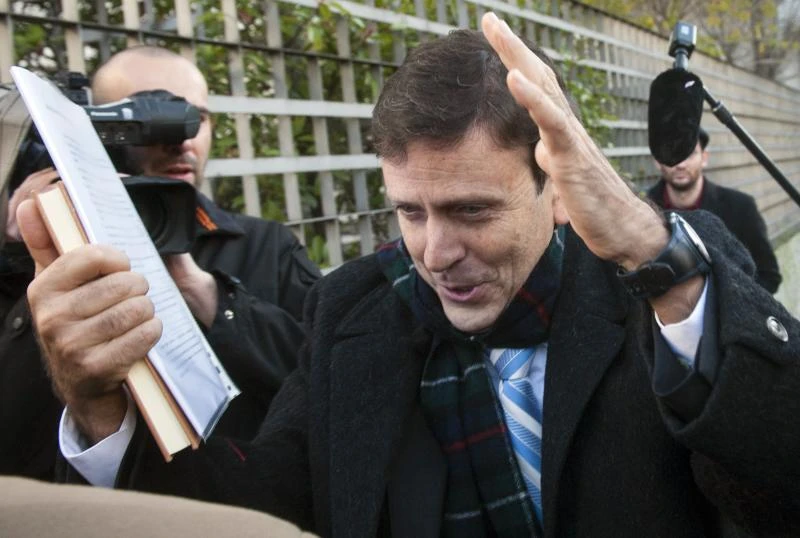
MADRID: A Spanish court on Tuesday sentenced a medical doctor who performed blood transfusions on top cyclists to a year in prison for endangering public health in a case keenly watched because of claims the practice extended to other sports.
Judge Julia Patricia Santamaria said that Eufemiano Fuentes, 57, offered the blood doping treatments for money, posing a “significant risk to the health” of those receiving the blood.
“The extractions and transfusions were not practised in accordance with the sanitary norms but in a clandestine manner,” she added in the long-awaited ruling after the 10-week trial in Madrid.
As such, his actions contravened article 361 of the Spanish criminal code, which relates to the endangering of public health, the judge said.
In addition to the one-year jail term, which under Spanish law he does not have to serve immediately if he lodges an appeal, Fuentes was given a fine of around 4,500 euros ($ 5,880, £ 3,790) at the rate of 15 euros a day for 10 months.
He was also banned from practising as a sports doctor for four years.
A former trainer of the Kelme cycling team, Jose Ignacio Labarta, was found guilty and handed a four-month jail term. He was given a four-month professional ban.
The three other co-accused in the case — Fuentes’ sister Yolanda, Manolo Saiz and Vicente Belda — were all cleared.
“Operation Puerto has finished and I hope that no one reminds me of it ever again,” said Saiz.
Operation Puerto refers to the police investigation against a wide-ranging blood-doping racket with Fuentes as its head.
Police arrested the accused in raids on premises linked to Fuentes in May 2006, leading to the seizure of some 200 bags of tampered blood labelled with a complex system of codes.
A virtual pharmacy of performance-enhancing substances, including the banned blood-booster erythropoetin (EPO), human-growth hormone (HGH) and anabolic steroids, was also uncovered.
A lawyer representing the International Cycling Union governing body described the operation as “the biggest doping network the world has ever seen.”
All five were charged with endangering public health but not incitement to doping, which was not a crime in Spain at the time of their arrests.
Judge Santamaria came under pressure during the trial to provide the names of athletes implicated in the scandal but she refused.
Doping case doctor sentenced to one year