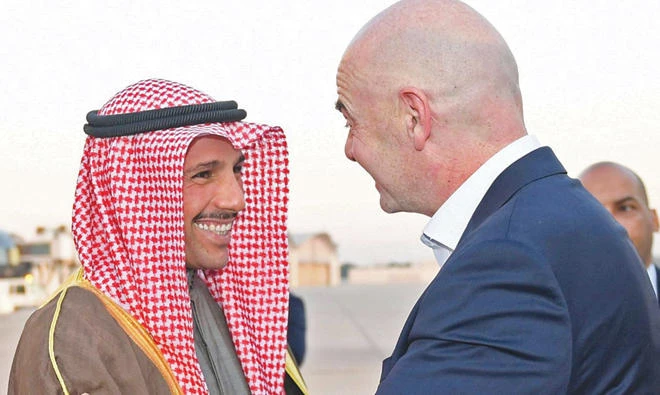
DUBAI: A two-year ban on Kuwaiti football by the sport’s international governing body FIFA is to be lifted with immediate effect, confirmed FIFA president Gianni Infantino from Kuwait City yesterday.
Infantino arrived in Kuwait yesterday morning for a tour of the country’s sporting facilities, including its landmark Jaber Al-Ahmad International Stadium where he will hold a press conference to formally announce the news. “The suspension of the Kuwait football association is lifted,” he announced via Twitter.
The lifting of the ban comes days after the Kuwaiti parliament voted in favor of amendments to the nation’s sport laws, making them compliant with the international principle of independence of sports associations.
FIFA suspended Kuwait in October 2015 for the second time since 2010 over alleged government meddling in sports. The International Olympic Committee followed suit with a ban on all sporting activity for the same reasons, leaving Kuwaiti athletes unable to compete in the 2016 Olympic Games in Rio.
The FIFA ban meant the Kuwait national team was disqualified from the 2018 World Cup qualifiers halfway through their Group G matches. The Blues were on track to progress to the third round with three wins and a draw from their first five games, but the remaining three matches were recorded by FIFA as 3-0 defeats.
Kuwait missed its chance to compete for a spot in the 2019 AFC Asian Cup in the UAE as a result of the suspension, with Macau replacing it in the qualifiers. The Blues dropped 65 places down the FIFA rankings from 123rd at the start of the ban to 188th, their worst position since the introduction of FIFA rankings in 1993.
At club level, Kuwaiti teams had won the AFC Cup for three years running between 2012 and 2014, and the domination was set to continue when both Al-Qadsia and Kuwait SC reached the semi-finals in 2015. However, both teams had to forfeit their fixtures against Malaysia’s JDT and Tajikistan’s Istiklol respectively when the FIFA ban came into effect.
The domestic league also suffered the effects of isolation. Despite the competition continuing to run, clubs were barred from acquiring players and coaches from abroad, causing stagnation and a notable drop in the level of the league.
The damage caused by two years of absence from the international sporting scene will continue for years. Kuwait’s next involvement in international football will be the 2022 World Cup qualifiers which kick-off in two years’ time.
Infantino arrived in Kuwait yesterday morning for a tour of the country’s sporting facilities, including its landmark Jaber Al-Ahmad International Stadium where he will hold a press conference to formally announce the news. “The suspension of the Kuwait football association is lifted,” he announced via Twitter.
The lifting of the ban comes days after the Kuwaiti parliament voted in favor of amendments to the nation’s sport laws, making them compliant with the international principle of independence of sports associations.
FIFA suspended Kuwait in October 2015 for the second time since 2010 over alleged government meddling in sports. The International Olympic Committee followed suit with a ban on all sporting activity for the same reasons, leaving Kuwaiti athletes unable to compete in the 2016 Olympic Games in Rio.
The FIFA ban meant the Kuwait national team was disqualified from the 2018 World Cup qualifiers halfway through their Group G matches. The Blues were on track to progress to the third round with three wins and a draw from their first five games, but the remaining three matches were recorded by FIFA as 3-0 defeats.
Kuwait missed its chance to compete for a spot in the 2019 AFC Asian Cup in the UAE as a result of the suspension, with Macau replacing it in the qualifiers. The Blues dropped 65 places down the FIFA rankings from 123rd at the start of the ban to 188th, their worst position since the introduction of FIFA rankings in 1993.
At club level, Kuwaiti teams had won the AFC Cup for three years running between 2012 and 2014, and the domination was set to continue when both Al-Qadsia and Kuwait SC reached the semi-finals in 2015. However, both teams had to forfeit their fixtures against Malaysia’s JDT and Tajikistan’s Istiklol respectively when the FIFA ban came into effect.
The domestic league also suffered the effects of isolation. Despite the competition continuing to run, clubs were barred from acquiring players and coaches from abroad, causing stagnation and a notable drop in the level of the league.
The damage caused by two years of absence from the international sporting scene will continue for years. Kuwait’s next involvement in international football will be the 2022 World Cup qualifiers which kick-off in two years’ time.