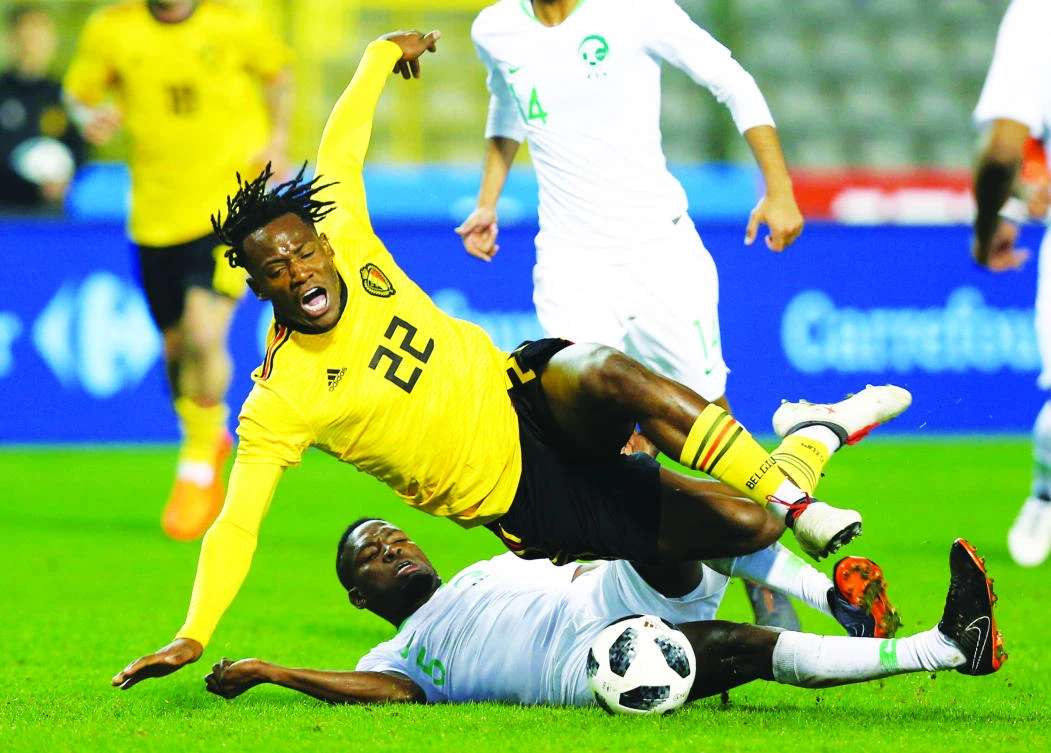
BRUSSELS: The jokes started after the third goal went in on Tuesday night.
“Has Pizzi been sacked yet?” came the question on social media. It was understandable given the previous Saudi Arabia manager, Edgardo Bauza, lasted only three games and was dismissed after losing 3-0 to Portugal. Juan Antonio Pizzi, whose team would eventually go on to lose 4-0 to Belgium, will know a premature end to his reign is not impossible.
Yet anybody who has watched the Green Falcons during this month’s preparation camp in Europe will have seen that Pizzi is making progress. His philosophy — pressing high, passing quickly, clever movement, and attacking in numbers — is becoming evident. The approach served him well with Chile as he won the 2016 Copa America and he believes he has the players to enjoy success with Saudi Arabia.
In the second half of last week’s draw with Ukraine, ranked 35th in the world and 34 positions higher than Saudi, the Arab side dominated and could have even sneaked a win. In the cold on Tuesday, despite playing against some of the best players in European football such as Eden Hazard and Kevin De Bruyne, the Saudi players stuck by their game plan, playing calmly out from defense and sending bodies forward at every opportunity.
But success will take time. Whether they can iron out the errors before June 14 is the biggest question. For all the comfort and courage Pizzi’s players show on the ball, they have been guilty of losing possession in dangerous areas. Ukraine were merciful; Belgium were less so.
Hassan Fallatah’s attempt to play a short pass out of defense in the 13th minute led to Romelu Lukaku opening the scoring after De Bruyne
pounced to intercept the misplaced pass. Even Abdullah Otayf, so often Saudi Arabia’s most intelligent player, handed Belgium a free shot at goal when his pass across the edge of the penalty area was jumped on by a Belgian shirt — fortunately for the Al-Hilal midfielder, Dries Mertens fired over.
Several Saudi players were also caught ball-watching, waiting for passes to arrive at their feet and failing to note their opponents sneaking in to steal possession. Housain Al-Mogahwi gifted Hazard a chance in the first half, while Mohammed Al-Sahlawi was slow to react on the rare occasions he was successfully picked out in attack. Unsurprisingly, he was removed with less than an hour played. Solving the striker issue will also be crucial if Pizzi’s team is to prosper.
Across 90 minutes, the Green Falcons managed only one shot on target and that came only after a misplaced pass from Salem Al-Dawsari ran into the path of the onrushing Fahad Al-Muwallad. How they could do with the physical presence of a Lukaku, who was a constant menace as Belgium racked up 28 shots at goal, 13 of which were on target.
After the match, Pizzi played down the result and pointed out that Belgium are one of the most talented teams in the world. While that much is true, this approach will only get him so far. With games against Algeria and Greece in May, followed by friendlies with Peru (ranked 11th in the world), Italy (14th) and reigning world champions Germany, there are certain to be more difficult days ahead.
But that was always Pizzi’s plan: Play quality teams in games where the results are irrelevant and use the matches to discover the players who can be relied on. In theory, such matches should stand Saudi Arabia in good stead for their group phase, where they join Russia, Uruguay and Egypt.
Unfortunately, as Bauza found out, every result is relevant to the Saudi Football Federation. Whether Pizzi will be allowed to carry his project to completion remains to be seen, but until he arrives in Moscow, the jokes are likely to continue. Any change now, with less than 12 weeks until the national anthem is played inside Luzhniki Stadium, would be ill-advised, especially since improvement is evident.
The Green Falcons are in transition — and they must learn to walk again before they can fly.