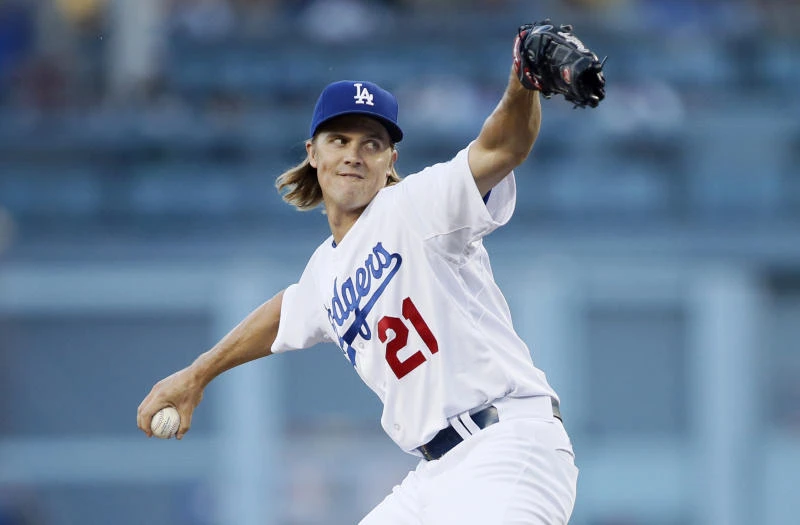
Alleged to be the smartest, richest, starriest team in baseball, the Los Angeles Dodgers have been almost as good this season as the National League's second wild card team. They have been branded as a colossus, a burgeoning powerhouse, a frightening mix of front-office intellect and ownership cash. But what are the Dodgers, really? They're a teetering first-place team with holes in need of patching, imperfect and not very different from a lot of good teams.
Much like the Nationals, the Dodgers have avoided collapse while treading far below their potential. After the Nationals beat them Monday night, the Dodgers slipped to 62-50 overall and 11-11 since the all-star break. The Dodgers remain in first place in the National League West, but only 2 ½ games ahead of the San Francisco Giants, whose rotation is currently held together with chicken wire. They have lost four games in a row, preventing them from taking advantage of the Giants' own four-game skid. If the Dodgers weren't in first, they'd be out of the postseason altogether, a game behind the Chicago Cubs in the NL wild-card race.
"There have been a couple scenarios this season where we could have really put a space between us and whoever," Manager Don Mattingly told reporters Monday. "We haven't done that."
The Dodgers' opening day payroll nudged past $230 million — $22 million more than the second-ranked New York Yankees and at least $100 million more than 21 teams. They remade their roster over the winter with a series of trades and signings, and they received praise for money wisely spent.
With team president Andrew Friedman and general manager Farhan Zaidi forming a new brain trust, the thinking went, the Dodgers would be more than a juggernaut. They would be an experiment, the answer to what happens when the brainiest guys in baseball get to spend the most money.
What's happened so far is this: They're pretty good, a team likely headed for the playoffs but still scrapping to ensure they will.
For all their financial might, the Dodgers have been too reliant on Clayton Kershaw and Zack Greinke. Of course, any team with perhaps the two starters in baseball helming their rotation would be built around them. The Dodgers' resources should mean they can be something other than mediocre for the other three-fifths of their schedule. They're not. They're 27-17 when Greinke or Kershaw start and 35-33 in all other games.
The Dodgers' most pressing issue has been their implosive bullpen. Although he's been shaky in the second half, closer Kenley Jansen has been solid, converting 21 of 22 save chances this season. Mattingly's attempts to get him a lead have frequently led to disaster.
Dodgers relievers have a collective 4.16 ERA this year, sixth-worst in baseball. Since the all-star break, the Dodgers' bullpen has managed a ghastly 6.68 ERA, blowing four saves in the process. The Dodgers tried to boost their relief by acquiring Jim Johnson from Atlanta at the trade deadline. In four appearances, he's already earned two losses, including a preposterous appearance against Pittsburgh in which he allowed eight earned runs and recorded two outs.
The Dodgers still have a chance to fix their bullpen with an August trade, a move that seems all but inevitable. They may also need to find a starter somehow, even after scrambling at the deadline to add two. Lefty Brett Anderson had been excellent for three months before the Nationals throttled him Monday night. Finding fourth and fifth starters following Brandon McCarthy's season-ending injury has been the new front office's biggest challenge so far.
They used their financial might to essentially buy players, including Mat Latos, from the Miami Marlins and nab Alex Wood from the Atlanta Braves. In four starts, Latos and Wood have combined for a 5.91 ERA. It would be foolish to judge the deal on such a small sample, but the deal was made with the sample of a half-season in mind, and so far the pair hasn't helped lessen the burden on Kershaw and Greinke.
The Dodgers may also need to fortify their shortstop position, either with a deal or with a managerial stroke. Jimmy Rollins, one of the players the new front office landed with their wave of moves this winter, has been a black hole. Dodgers shortstops rank 27th in baseball in wins above average, per Baseball-Reference. Rollins owns a .278 on-base percentage, which makes it maddening that he continues to hit at the top Los Angeles's lineup. He's batted leadoff 30 times this season, including the Dodgers' last 11 games. The solution could be Corey Seager, the consensus top prospect in baseball.
Seager represents the future, and that's where the Dodgers' vault of money and assets makes them dangerous.The Dodgers spent about $40 million in the international market this July, one of the places where deep pockets can best be exploited. They've got Seager and 19-year-old Julio Urias, an elite pitching prospect, poised to break into the majors. They just acquired Jose Peraza, the No. 26 prospect in the sport according to Baseball America, at the deadline in their massive deal with the Braves and Marlins. Greinke can opt of his deal at the end of the winter, and the Dodgers are one of the few teams who can match his asking price.
Friedman and Zaidi would have been foolish to leverage the Dodgers' future for this season, and they have maintained a war chest. There's no question the pair is smart, and poised to keep the Dodgers a contender. But this season's challenges have shown that there are plenty of other smart teams, too, and that money guarantees nothing. The Dodgers are a good team that has a chance to get better, and the organization has a bright future. Like the team they're playing right now, they still have to prove it.
Weren't the Dodgers supposed to be a powerhouse?