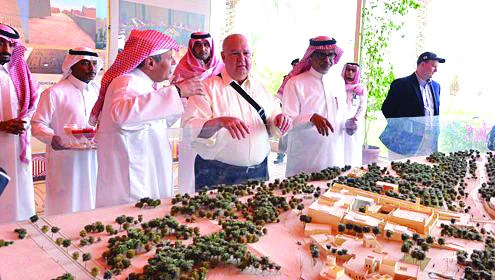
The historic Diriyah area in Riyadh represents the rich history and heritage of Saudi Arabia, the United States ambassador said earlier this week.
The construction taking place in the area, under the auspices of the Saudi Commission for Tourism and Antiquities (SCTA), would transform the area into a major cultural and tourism destination, said Joseph W. Westphal during his visit with embassy staff.
Saudi officials who accompanied him on a tour of the area included Hussain Abu Al-Hassan, acting vice-president of the SCTA, Abdul Aziz Al-Basyoni, director of Diriyah’s antiquities office, and others from the Riyadh Development Authority.
Westphal was briefed on the development underway and watched a documentary before touring the Turaif Quarter, which is a United Nations Educational, Scientific and Cultural Organization (UNESCO) World Heritage Site.
UNESCO declared Turaif, one of three main districts in Diriyah, a world heritage site in 2010. It is the second historic site in the Kingdom to be added to the list. The first was Madain Saleh in 2008.
The district was the site of the first capital of the Saudi state in the heart of the Arabian Peninsula, northwest of Riyadh. Founded in the 15th century, the district has buildings constructed in the Najdi architectural style.
The plan underway is to restore some of the buildings, upgrade and modernize infrastructure and establish cultural institutions that will manage museums, exhibitions and activities such as heritage markets and falconry shows.
The museum and other buildings will integrate the site’s landmarks and archaeological remains within the natural environment of the quarter. Exhibitions and live interactive shows will be held to attract a wide spectrum of visitors.
Turaif contains government buildings such as Salwa Palace from the first Saudi state. One of its key landmarks is the Imam Mohammad bin Saud Mosque, and the palace of Saad bin Saud, consisting of two stories with an external courtyard that was used as a stable.
Diriyah ‘embodies KSA’s rich history’