TOKYO: Shinzo Abe took office Wednesday for a third term as Japan’s prime minister, but the return to power stirred warnings from China over a bid to change the pacifist constitution.
Parliament re-elected Abe after his Liberal Democratic Party won a renewed mandate in a Dec. 14 snap election that the prime minister said was needed for him to carry out further economic and political reforms.
His new Cabinet was largely unchanged with Taro Aso returning as deputy premier and finance minister, Fumio Kishida as foreign minister and Yoichi Miyazawa in the industry minister post.
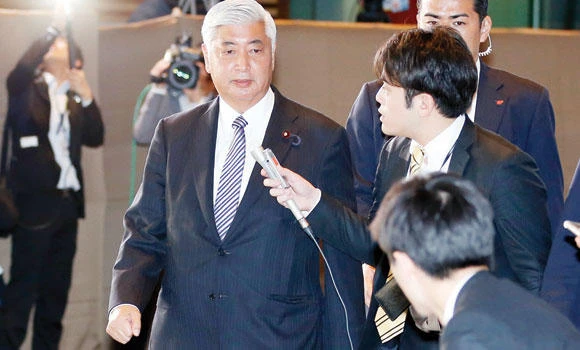
The only new face was Gen. Nakatani, replacing Akinori Eto as defense minister after Eto declined reappointment in the midst of a political funding scandal. Gen. Nakatani headed the Defense Agency in 2001-2002 under former Prime Minister Junichiro Koizumi, before it won full-fledged ministry status. A graduate of the National Defense Academy, he attained a rank of first lieutenant before leaving the military.
Nakatani favors a stronger role for the military, which is constrained by the country’s commitment to pacifism under the constitution drafted by the American occupation forces following Japan’s defeat in World War II.
Nakatani said Abe specifically asked him to tackle “national security in order to protect Japanese territory, the people’s lives and properties.”
This time, “I feel more strongly about my responsibility,” he said. “Japan’s security environment has changed, and we must fortify our national security.”
Nakatani’s predecessor, Akinori Eto, was one of several ministers whose political funding reports were questioned by opposition lawmakers during the recent parliamentary session. Two resigned their Cabinet posts but were re-elected anyway.
Abe favors revising the constitution as part of his effort to fortify Japan’s military, after already revising policies to allow the defense forces to aid allies if they come under attack under a policy dubbed “collective self-defense.” Analysts said Abe likely wanted a stronger figure to help handle anticipated fierce questioning over defense-related issues in upcoming parliamentary debates.
Abe returns for 3rd term as Japan’s leader