OUAGADOUGOU: The chief of the African Union on Monday arrived in Burkina Faso for urgent talks on the West African country’s political transition following the ouster of veteran president Blaise Compaore.
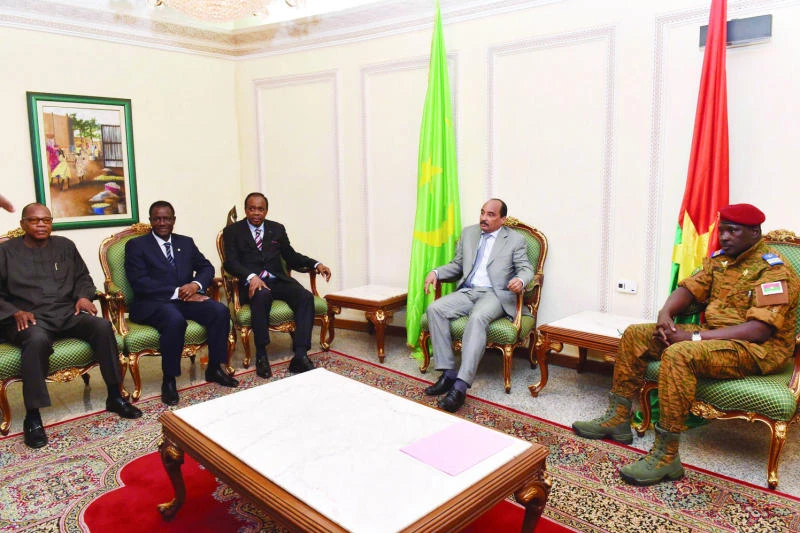
“We have come to participate in a solution,” Mauritania’s president and current AU head Mohamed Ould Abdel Aziz said after talks with Lt. Col. Isaac Zida, the officer the army installed to lead the nation after Compaore fled.
Abdel Aziz’s visit came a day after the opposition and civil society groups agreed on a blueprint for transition that provides for new elections in a year. The deal now has to be negotiated with the military, which is under international pressure to stand down.
After publicly embracing Zida, the AU head went straight into private talks with the soldier in a lounge at Ouagadougou airport. No details emerged from their discussion, which preceded talks in the city itself between Abdel Aziz and other parties to the political process.
“The African Union has not come to sanction Burkina Faso,” Abdel Aziz stated on emerging from the talks with Zida, adding that a settlement would come from “the Burkinabe people.”
The AU chief then traveled to a luxury hotel in the capital for meetings with opposition politicians and leaders of civil society, as well as loyalists who had backed the increasingly unpopular Compaore in office.
“The African Union is there to accompany them (parties to transition). They have already taken the essential steps for more democracy in their country,” Abdel Aziz said.
Though Zida’s regime rejected a recent ultimatum from the AU to stand down within a fortnight, Abdel Aziz said he wanted “to congratulate” all parties to the succession crisis and urged them to go on working together “in tranquility, security and social peace.”
Compaore first seized power in a 1987 coup that killed his predecessor and former comrade-in-arms Thomas Sankara, a widely popular Marxist and reformer under whom the name of the country was changed from Upper Volta to Burkina Faso, meaning “Land of Upright People.”
Compaore fled the country under pressure from mass demonstrations and unrest, with parliament set ablaze, in protests against measures to change the constitution to extend his 27-year rule. He has found refuge in another former French colony, neighboring Ivory Coast.
African Union chief in Burkina Faso for transition talks