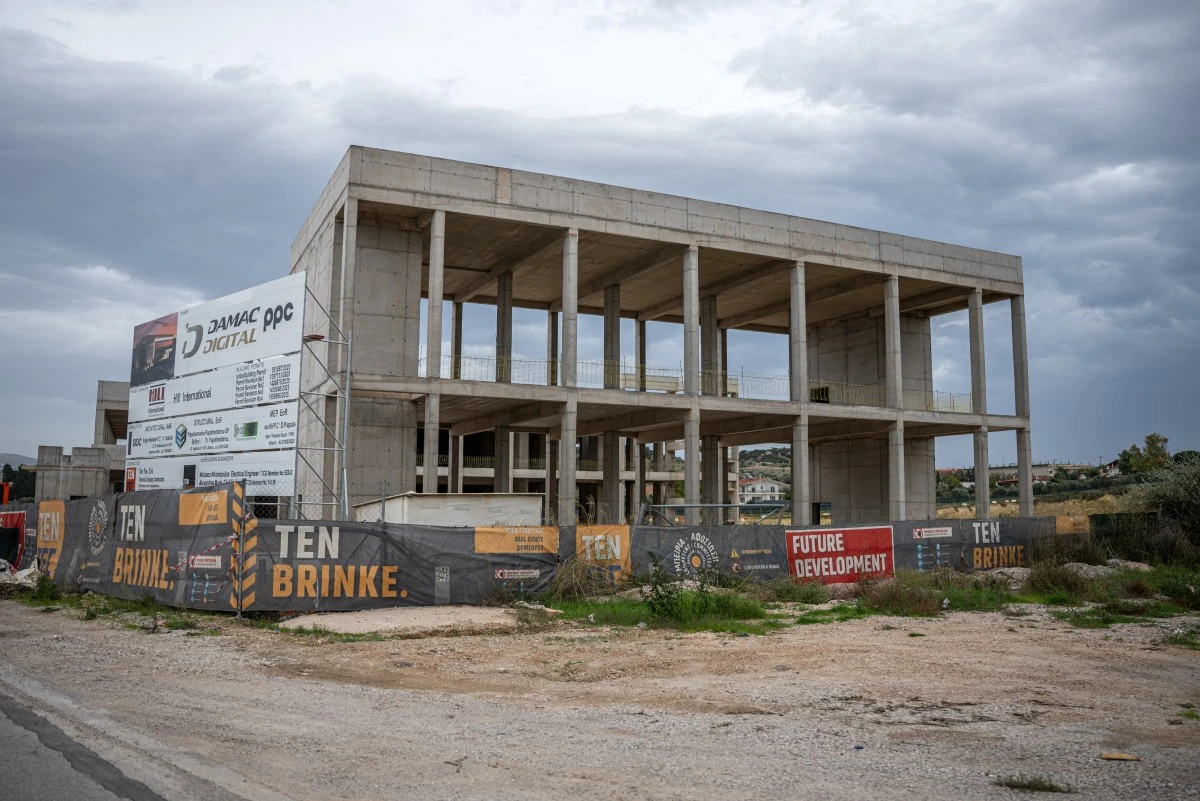
- Multiple data centers are being constructed in Spata, near Athens
- Residents warn the data centers will disrupt the area’s quiet environment
CHRISTOUPOLI: As the sun sets in the semi-rural community of Spata near Athens, a group of pupils stretch on the sports pitch of Pierce College, one of Greece’s top international schools.
The quiet setting will be very different in a few months’ time, when a large data center will start going up opposite the school grounds.
Two more data centers are already under construction in the broader area, putting the whole district on edge.
“We are not against technological development. What we ask is that it be done in harmony with our lives and property. Not in an anarchic way just because (data centers) are in vogue,” Spata local Yiorgos Minardos told AFP in a meeting with other residents.
Minardos’s home in the small nearby community of Christoupoli is less than 200 meters from another, 150-million-euro ($165-million) data center under construction on behalf of Greece’s Public Power Corporation (PPC), the main electricity provider, and Dubai real estate developer Damac.
Once covered in olive groves and vineyards, the broader Spata area, some 20 kilometers (12 miles) east of the capital, has already seen rapid development since the Athens airport relocated there in 2001.
Data center drive
A raft of data centers nationwide is being energetically promoted by the conservative government of Prime Minister Kyriakos Mitsotakis.
It says it wants to develop Greece into a major data and infrastructure hub for the southeastern Mediterranean and the wider region.
“We are working with dedication to ensure that Greece is equipped with the necessary infrastructure to consistently rank among the leading and pioneering countries in the economic transformations already taking place,” the prime minister said last year.
Residents counter that state and regional officials have allowed the construction of industrial-scale facilities near their homes that are incompatible with the area’s commercial zoning regulations.
Nearly 40 residents challenged the data center permits in a 2025 complaint at the Council of State, Greece’s top administrative court. The case is to be heard in February.
‘Critical’ data hub
PPC has said that its 12.5 MW data center “is poised to become a critical hub connecting Europe, Asia, and Africa, reinforcing Greece’s position as a leader in IT capacity in Southeastern Europe.”
Originally slated for completion this year, it is still a concrete husk.
A larger project built for Microsoft a few hundred meters away, 19.2 MW in capacity, is designed to “minimize energy consumption,” according to its construction company Renco.
But confirming residents’ concerns, Renco’s construction partner Terna called the Microsoft center an “industrial-type facility.”
The third center near Pierce College, jointly developed by the investment firm Pimco, will have a capacity of up to 80 MW.
Budgeted at 300 million euros, it is slated for completion in 2028, as is the Microsoft facility, worth some 100 million euros.
The government in March presented a study by consultancy PwC pointing to investor interest in developing data center capacity of over 1 GW, more than 20 times the current level.
There are more than 35 investment requests, the study said, mostly in the greater Athens area.
AI power demand
In a question to parliament in October, former socialist prime minister George Papandreou warned the technology “can exert significant pressure on electrical grids, increase the cost of the required infrastructure, and pass part of that cost on to consumers.”
The International Energy Agency has said data center electricity demand in Europe is projected to increase by 70 percent by 2030.
Meta, Google, Microsoft and Amazon are all investing heavily to meet growing demand for their AI products and services.
But resistance to data centers is growing in Europe and elsewhere.
In the United States, local opposition blocked or delayed at least 75 such projects in the first quarter of 2026, according to the monitor Data Center Watch.
They require lots of fresh water to help cool servers, raising fears of localized shortages.
“Large providers use evaporative cooling systems that require water on roughly 15 percent of the days in a year,” said Elissavet Feloni, an assistant professor at the University of West Attica’s school of engineering.
That demand “coincides exactly with heatwave days ... precisely when (water) reservoirs are under maximum stress.”
Heatwave concerns
Christoupoli residents said they were incensed when the company building one of the data centers told them to “simply shut their windows and put on air-conditioning” to cushion the noise of the cooling machinery.
They also fear the facilities will heat up the land around them, in an area already prone to heatwaves.
“When it’s quiet at night, we can hear the lions and apes” at the zoo, said local homeowner Ioannis Alatinis.
“Given the jungle this place is going to turn into, it’s kind of fitting.”