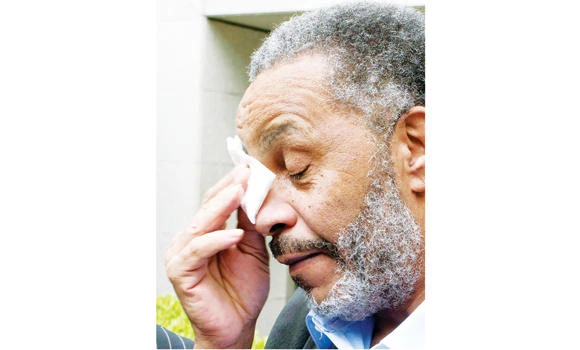
BIRMINGHAM, Alabama: Anthony Ray Hinton, 58, spent half his life on Alabama’s death row, sentenced to die for two 1985 murders that for decades he insisted he did not commit.
Over 28 years, the outside world changed while Hinton spent his days largely in a 5-by-8-foot prison cell. Children grew up. His mother died. His hair turned gray. Inmates he knew were escorted off to the electric chair or the lethal-injection gurney.
He was set free Friday after new ballistics tests contradicted the only evidence — an analysis of crime-scene bullets — that connected Hinton to the slayings.
“They had every intention of executing me for something I didn’t do,” Hinton said outside the Jefferson County Jail in Birmingham.
Friends and family members rushed to embrace Hinton after his lawyers escorted him outside of the jail on Good Friday morning. His sisters wiped tears, saying “Thank you, Lord,” as they wrapped their arms around their brother.
Equal Justice Initiative director Bryan Stevenson, who waged a 16-year fight for Hinton’s release, said while the day was joyous, the case was tragic.
“Not only did he lose his life, he lived a life in solitary confinement on death row, condemned in a 5-by-8 cell where the state was trying to kill him every day,” Stevenson said.
Hinton was convicted of killing two fast-food-restaurant workers — John Davidson and Thomas Wayne Vason — during separate 1985 robberies at Mrs. Winner’s and Captain D’s restaurants in Birmingham. Investigators became interested in him after a survivor at a third restaurant robbery picked Hinton out of a photo lineup.
The only evidence linking him to the slayings were bullets that state experts then said had markings that matched a .38-caliber revolver that belonged to Hinton’s mother. There were no fingerprints or eyewitness testimony.
Stevenson said a defense analysis during appeal showed that bullets did not match the gun. He then tried in vain for years to persuade the state of Alabama to re-examine the evidence.
A breakthrough came last year when he won a new trial after the US Supreme Court ruled Hinton’s trial counsel “constitutionally deficient.” His defense lawyer wrongly thought he had only $1,000 to hire a ballistics expert to rebut the state’s case. The only expert willing to take the job at that price — a one-eyed civil engineer with little ballistics training who admitted he had trouble operating the microscope — was obliterated on cross-examination.
Alabama man after death row: Prosecutors will ‘answer to God’