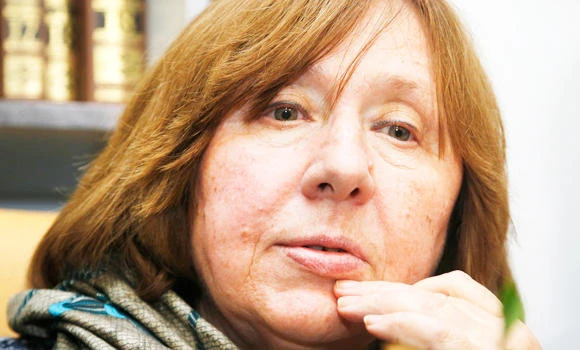
STOCKHOLM: Belarussian writer Svetlana Alexievich won the 2015 Nobel Literature Prize on Thursday, honored for her work chronicling the horrors of war and life under the repressive Soviet regime. The Swedish Academy hailed the 67-year-old for writings that were “a monument to suffering and courage in our time” — tableaux of World War II, Chernobyl and the war in Afghanistan, crafted through thousands of interviews.
“By means of her extraordinary method — a carefully composed collage of human voices — Alexievich deepens our comprehension of an entire era,” it said. Alexievich dedicated the prize to her native Belarus.
“It’s not an award for me but for our culture, for our small country, which has been caught in a grinder throughout history,” she told a press conference in Minsk. History showed there was no place for deals with oppressors, Alexievich added.
“In our time, it is difficult to be an honest person,” she said. “There is no need to give in to the compromise that totalitarian regimes always count on.”
In separate comments to daily Svenska Dagbladet, she said the prize would help the fight for freedom of expression in Belarus and Russia. “I think my voice will carry more weight now... It won’t be so easy for those in power to dismiss me with a wave of the hand anymore. They will have to listen to me,” she said.
Alexievich, only the 14th woman to win the prize since it was first awarded in 1901, had been the top choice among literary observers and among the bookies’ favorites.
The Academy’s permanent secretary, Sara Danius, speaking to the Nobel Foundation, called her “an extraordinary writer,” saying “it’s a history of emotions she’s offering us.”
By chronicling her thousands of interviews, “she’s offering us a history of (Man), about whom we didn’t really know that much, at least not in this systematic manner. At the same time she’s offering us a history of emotions. A history of the soul if you wish,” she said.
“She has invented a new literary genre where she transcends journalism. Others have been there too but she expanded it,” Danius said.
Alexievich wins Nobel Literature Prize