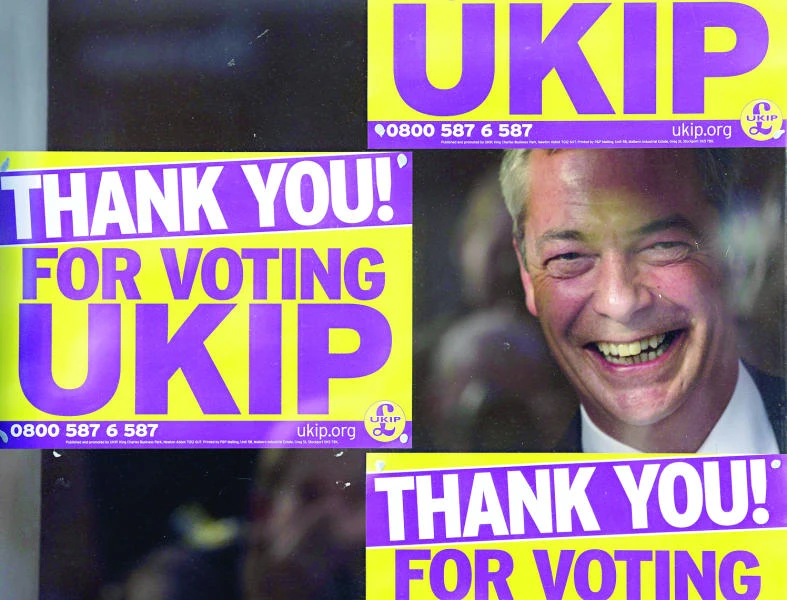
CLACTON-ON-SEA, United Kingdom: Britain’s anti-EU UK Independence Party won its first seat in the House of Commons Friday, sending jitters through Prime Minister David Cameron’s Conservatives seven months before what is likely to be a tight general election.
Conservative defector Douglas Carswell’s victory in Clacton came as UKIP also narrowly lost out on a shock victory in a second by-election on Thursday in Heywood and Middleton, traditionally a stronghold of the main opposition Labour party.
Support for UKIP, which wants Britain to leave the European Union and to restrict immigration severely, has soared in the last two years amid increasing disenchantment with mainstream political parties.
The party once dismissed by Cameron as “fruitcakes, loonies and closet racists” came top in May’s European elections.
Its leader Nigel Farage now claims it could win enough seats to hold the balance of power if next May’s general election produces no overall winner.
“In our target seats, if you vote UKIP you get UKIP,” Farage said during a celebratory tour of the seaside town.
“They’re realizing that as a result of EU membership the British government is impotent over vast areas of our lives.”
UKIP’s support for leaving the EU is central to its appeal.
While Cameron has promised a referendum on leaving the EU if he is re-elected with a majority next year, he is opposed to the move if he can renegotiate Britain’s terms of membership.
Carswell turned his previous majority of 12,068 for the center-right Conservatives in 2010 into one of 12,404 for UKIP this time around, winning 60 percent of the votes cast in Clacton, southeast England.
In Heywood and Middleton, part of Greater Manchester in northwest England, center-left Labour slumped from a majority of nearly 6,000 in 2010 to one of just 617, with UKIP in second place.
Carswell called it the night’s “really significant” result as it showed UKIP could prosper in Labour heartlands, piling further pressure on Miliband.
His party is only narrowly ahead in most opinion polls while his personal popularity ratings lag well behind those of Cameron and Farage amid suggestions from experts that his geeky persona fails to connect with many voters.
“I know people voted for UKIP in this by-election, but I do not believe UKIP is a party that can represent the interests of working people,” said the embattled leader.
Anti-EU party wins first seat in British Parliament