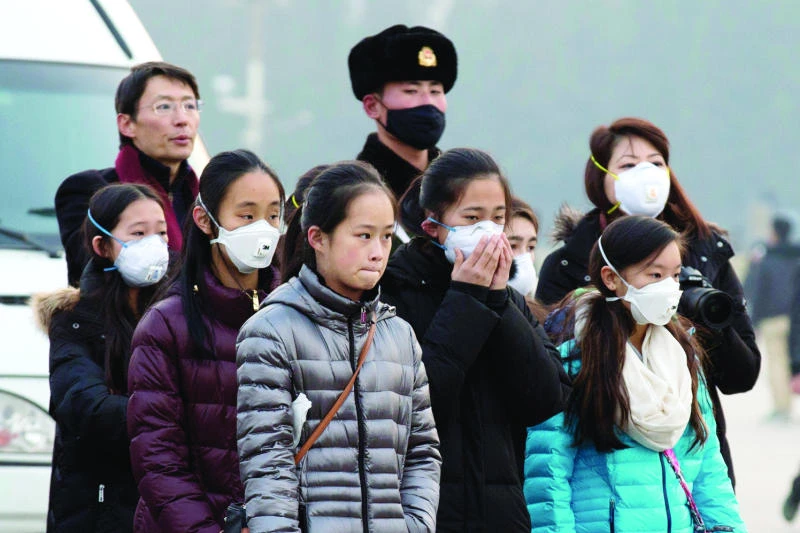
BEIJING: Beijing issued its second-ever red alert for smog and put its emergency response plan into action once again as severe pollution hit China’s capital on Saturday.
The notice from the capital’s environmental bureau ordered factories to close and pulled half of all private cars off the streets, among other measures, as bad air flooded into the city for the third “airpocalypse” of the month.
The red alert, the highest tier of a four-color warning system, will last from Saturday to Tuesday, according to a statement on the Beijing Municipal Environmental Protection Bureau’s website.
It is the second time the highest level alert has been issued since the city established a pollution warning system in 2013.
Counts of PM2.5 — harmful microscopic particles that penetrate deep into the lungs — were above 260 micrograms per cubic meter earlier Saturday, according to the US Embassy, which issues independent readings. The World Health Organization’s recommended maximum exposure is 25 over a 24-hour period.
By mid-afternoon the reading lowered to 140, but the pungent smelling smog still reduced visibility in the capital even though the streets were not as clogged with vehicles as usual.
“Environmental protection is an important objective the Chinese government has been firmly working on,” Foreign Ministry spokesman Hong Lei said at a regular scheduled briefing in Beijing.
But, he added: “We are still facing some challenges in environmental protection.”
The national environmental bureau said that other cities in the region would raise their alert level to red, adding it had urged regional governments to “implement heavy air pollution emergency response measures.”
The soupy haze did not turn off several elderly people who headed to Beijing’s parks and public squares to do their morning exercises.
But residents on social media were seemingly more bothered by the latest bout of heavy haze and said the government was not doing enough to tackle the problem. “Whether or not I drive my petrol car has little to do with the main causes of smog,” one user on China’s Twitter equivalent Weibo said.
“If alternating traffic is effective in controlling smog, why not set it up permanently?” said another commenter.
Beijing issues second red alert as choking smog sets in again