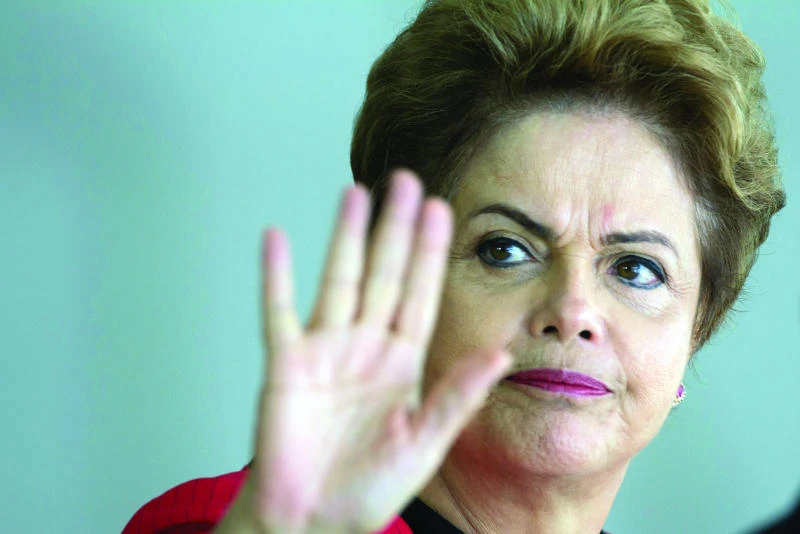
RIO DE JANEIRO: If the worst economic crisis in a decade, a massive corruption scandal centered on her ruling party and approval ratings in the single digits weren’t rough enough for Brazilian President Dilma Rousseff, she’s now faced with growing calls for her impeachment.
Eduardo Cunha, the powerful speaker of Brazil’s lower house of Congress, is Rousseff’s sworn enemy and has been charged by her attorney general with taking millions in bribes in connection with a sprawling corruption scandal at state-run oil company Petrobras.
He’s also the man who can call for an impeachment vote in the Chamber of Deputies against the president, an action that two-thirds of Brazilians say they want to see happen, according to polls.
“Dilma is walking on the high wire without a net,” said Eliane Cantanhede, one of Brazil’s best-known political commentators for the Estado de S. Paulo newspaper and Globo television. “Nobody knows what Cunha is going to do, and this situation is a double-edged sword for Dilma.”
Cunha, an avowed obstructionist to important economic and political reform measures Rousseff needs to push through Congress, was weakened after federal prosecutors charged him last week with corruption, which “may be good for Dilma, because he’s losing the political backing to push through impeachment,” Cantanhede said.
“But as a weakened figure, he also becomes a political suicide bomber, because nobody knows what he’ll tell prosecutors,” she added. “Nobody knows what he knows.”
A few months ago, most analysts said the threat of impeachment against Rousseff was only a distant possibility.
She’s not been accused of wrongdoing in the Petrobras case, in which dozens of federal deputies, senators and other top political figures are under investigation, along with some CEOs of Brazil’s top construction and engineering firms who are already jailed. Prosecutors allege the kickback scheme involved roughly $2 billion in bribes paid by companies in return for grossly inflated building contracts over more than a decade.
But with an economy in recession, along with growing inflation and unemployment, Rousseff has the worst approval rating for any president since Brazil’s return to democracy in 1985.
Brazil’s Rousseff faces growing impeachment threat