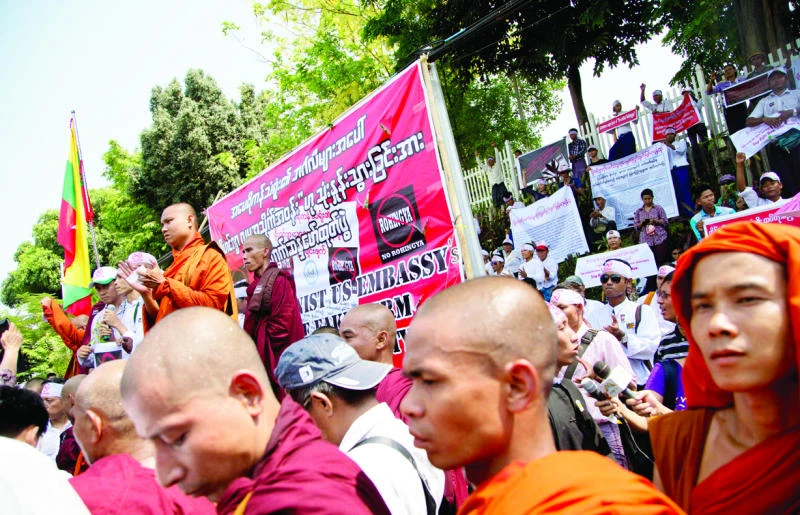
YANGON: Buddhist monks have joined several hundred protesters outside the US Embassy in Myanmar to demand it stop using the term “Rohingya” to refer to a Muslim ethnic minority group.
The protesters insisted the group be called “Bengali” and be regarded as illegal migrants from Bangladesh. The families of many members of the minority have lived in Myanmar for generations.
Myanmar does not officially recognize the Rohingya as an ethnic group, and denies most of them citizenship and basic rights. Conflict over land in the western state of Rakhine, where most of the estimated 1 million Rohingya live, caused violence between Buddhists and Muslims which later spread to other parts of the country.
The US Embassy used the term “Rohingya” this month in a statement of concern about their situation.
The Rohingya, most of whom live in apartheid-like conditions, are seen by many Myanmar Buddhists as illegal immigrants from Bangladesh.
The demonstration was sparked by a statement from the embassy last week expressing condolences for an estimated 21 people, who media said were Rohingya, who drowned off the coast of Rakhine State and came just a day after President Htin Kyaw accepted the credentials of the new US Ambassador, Scot Marciel.
“Today, we, from here, want to declare to the US Embassy and the ambassador to Myanmar, to all the other countries, that there is no Rohingya in our country,” Parmaukkha, a monk and member of the hard-line Buddhist group Ma Ba Tha, told about 300 people who gathered on a busy road across from the embassy compound.
“If the US accepts the term ‘Rohingya,’ you (US) should take them back to your country.”
The previous government referred to the group as Bengalis, implying they were illegal immigrants from Bangladesh, despite many having lived in Myanmar for generations.
Aung San Suu Kyi, the leader of the ruling National League for Democracy party and state counsellor, has drawn criticism from rights groups for avoiding using the term Rohingya and not doing enough to address their plight.
Thousands have fled persecution and poverty in the country.
Some 125,000 Rohingya remain displaced and face severe travel restrictions in squalid camps since fighting erupted in Rakhine between Buddhists and Muslims in 2012.
Zaw Htay, spokesman at the state counsellor’s office, said on Thursday that the name issue was being handled by the Ministry of Foreign Affairs and would be addressed in a “diplomatic way” but did not provide further details.
A spokesman for the US Embassy said the US supports the right to demonstrate and added that “around the world, people have the ability to self-identity.”
Lt. Col. Kyaw Htut, head of the western Yangon region police, said the protest organizers would face charges for holding the demonstration in an unapproved location.
Buddhist monks target US Embassy against Rohingya