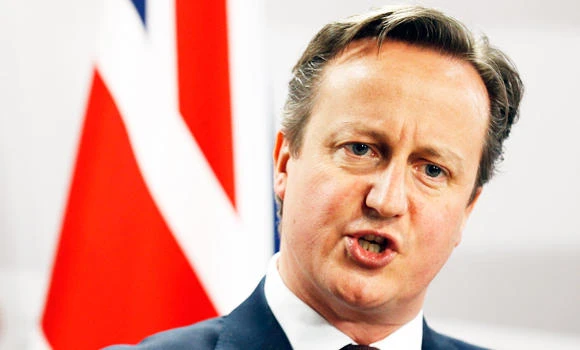
RIGA, Latvia: Prime Minister David Cameron said Friday he was “confident” of striking an EU reform deal to put before British voters by 2017 but warned of “ups and downs” in the process.
On his first overseas trip since winning a general election two weeks ago, Cameron kicked off months of negotiations to persuade other European leaders of the need for reforms which he says will require treaty change.
“I’m confident because in the end I think it’s in everybody’s interests,” Cameron told reporters after a summit of the 28-nation bloc and six former Soviet states in Riga.
But he also warned there would be “lots of noise, lots of ups and downs along the way” from other European states questioning his proposals.
Facing pressure from euroskeptics two years ago, Cameron promised to allow Britons to vote in a referendum by the end of 2017 on whether to leave Europe if he won this year’s election.
Having secured victory with a surprise outright majority, he will now campaign to stay in the EU as long as he can secure reforms such as making it harder for EU migrants to claim state benefits in Britain.
Opinion polls currently indicate that Britons will vote in favor staying part of the EU.
Cameron’s preliminary talks with a string of leaders will be followed by a spell of intense diplomacy next week. He will host European Commission head Jean-Claude Juncker at his country residence, Chequers, on Monday, before traveling to Paris and Berlin for talks on Thursday and Friday respectively.
The British leader’s main goals include controlling migration by making it harder for EU migrants to claim state benefits in Britain, opting out from the EU’s commitment to “ever closer union” and handing powers back to national parliaments.
In Riga, he met leaders including Poland’s Ewa Kopacz and Hungary’s Viktor Orban for brief, general discussions on his reform agenda, British officials said.
“It was a pitch about why these issues matter to the British people, why he needs to address them, broader concerns around immigration, the direction of the EU,” one official added, speaking on condition of anonymity. But French President Francois Hollande said he had not spoken to Cameron about the reforms.
“It was not the place and it was not the time,” Hollande added of the summit focused on developing the EU’s partnerships with former Soviet states including Ukraine, highlighting that the two would meet next week.
Britain, Europe’s second largest economy and a permanent member of the UN Security Council, is a member of the EU but has kept its own currency rather than adopting the euro.
Neither is it part of the Schengen Area, the group of 26 European countries which have abolished passport and border controls at common borders.
The main focus of the Eastern Partnership summit was on developing the EU’s relationship with Armenia, Azerbaijan, Belarus, Georgia, Moldova and Ukraine.
In their final declaration, European leaders reaffirmed the “high importance” of building stronger relations with the states.
But EU president Donald Tusk said afterwards that, while the EU would be a “partner for the long haul,” the partnership would not lead to automatic EU membership.
“Nobody promised that the Eastern Partnership would be automatically the way to membership of the EU... it will be a long process,” he said.
The summit declaration also urged the full implementation of the Minsk peace accords in Ukraine and reaffirmed its position on the “illegal annexation” of Crimea by Russia last year.
The leaders met following a 2013 summit which ended in chaos when Ukraine’s then president, pro-Russian Viktor Yanukovych, balked at signing an EU association accord alongside Georgia and Moldova.
His refusal sparked massive pro-EU protests that led to his ouster in February 2014, then to Russia’s annexation of Crimea and a bloody conflict in eastern Ukraine.
Cameron ‘confident’ of EU reform agreement