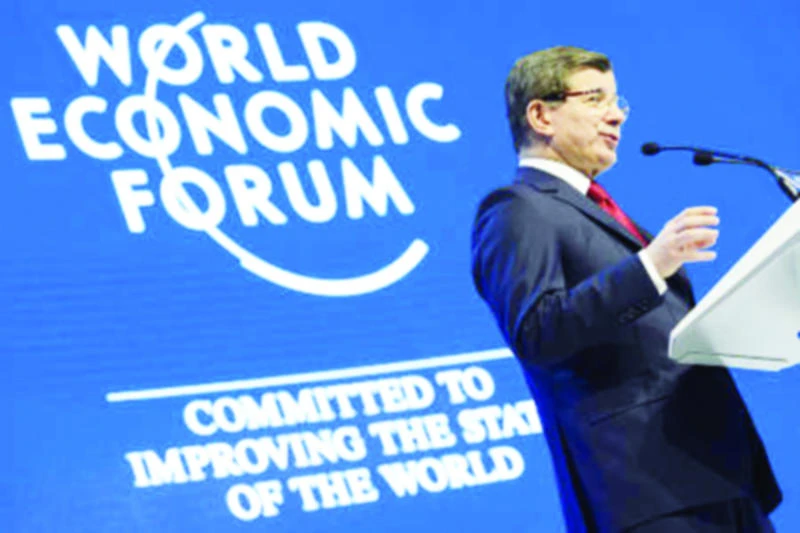
DAVOS: With a symbolic handshake at the World Economic Forum, the leaders of Cyprus pledged their commitment to reach a settlement to reunite their divided Mediterranean island this year and appealed for international financial support.
Cypriot President Nikos Anastiades and Turkish Cypriot leader Mustafa Akinci made an unprecedented joint appearance before global business and political leaders in Davos to proclaim their aim to build a peace bridge between Europe and the Middle East.
“At a time when Europe is enduring a deep crisis, primarily linked to the tragic events unfolding in Cyprus’ immediate neighborhood, myself and Mustafa are working tirelessly to reunify our country,” Anastasiades said.
He called for a substantial financial contribution from the international community to finance a solution for Cyprus.
Both leaders stressed that they had not yet concluded a deal and that difficult issues remained over territory, property and compensation, but both said they were working for an agreement in 2016.
WEF president Klaus Schwab called Cyprus “a ray of hope just where the Middle East meets Europe.”
Cyprus has been split since Turkish forces invaded the north of the island in 1974 in response to a short-lived Greek Cypriot coup backed by Greece’s then military rulers.
The last attempt to broker a settlement foundered in 2004 when Greek Cypriots rejected a U.N. peace plan accepted by the Tukish Cypriots, and Cyprus joined the European Union as a divided island, leaving the Turkish Cypriots isolated. Akinci said he and Anastasiades were of the same generation and represented the last chance to reunite the island. The generation born after them knew only division.
Energy cooperation based on recent offshore gas discoveries off Cyprus could provide a crucial incentive to reach a deal, he said.
“With this solution, newly found hydrocarbon resources in the Eastern Mediterranean will act as a source of peace and cooperation rather than conflict and tension,” Akinci said. In a concerted international drive to support the peace process, UN Secretary-General Ban Ki-moon hosted a lunch with the two leaders and US Vice President Joe Biden also met them to offer his backing.
A diplomatic source in New York said the UN special envoy for Cyprus, former Norwegian Foreign Minister Espen Barth Eide, had told the Security Council in a closed session last week that 90 percent of a Cyprus deal was done but the last 10 percent remaining was the most difficult.
Meanwhile, leaders at Davos warned taht the European Union could unravel if member states fail to agree a common approach to the refugee crisis and security challenges in the next few months.
A day after Austria announced a formal cap on the number of refugees it would allow in this year, raising pressure on German Chancellor Angela Merkel to do the same, top European politicians pleaded for a deal in which states would agree to accept quotas of refugees.
But they admitted that such an agreement remained elusive, with many countries, including much of central Europe, refusing to accept any migrants.
“I’m not naive,” Swedish Prime Minister Stefan Lofven told reporters when asked about the prospects of a quick deal.
“My argument to the countries that are not willing to accept refugees is that if we can’t handle this the European Union is at risk,” he said.
Cyprus leaders at Davos pledge unity, seek support