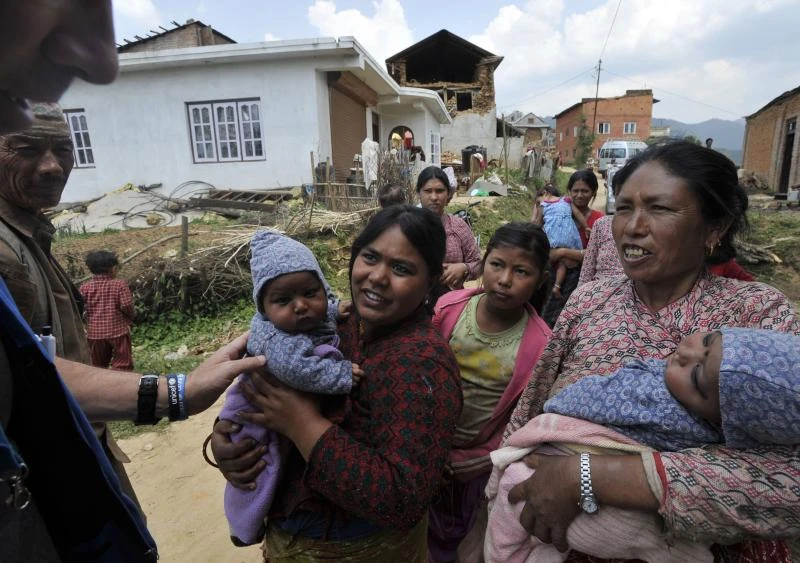
KATMANDU: More than a thousand engineers were checking damaged houses in Nepal’s capital Wednesday and advising people about whether they are safe.
About 13,000 families have requested inspections of their homes since the massive magnitude-7.8 earthquake near Katmandu on April 25, Nepal Engineers Association General Secretary Kishore Kumar Jha said. More than 7,600 people died in the quake.
The association, which has 2,000 civil and structural engineers, has set up phone lines for people to request inspections.
“We have been receiving calls constantly. We are trying to reach as many people as possible,” Jha said.
About 40 percent of the damaged houses inspected so far were considered safe, he said.
It is still unclear how many houses were damaged in the capital and how many are repairable.
Some modern buildings — including upscale hotels and expensive homes — appear to have escaped largely unscathed. But there is widespread damage in poorer neighborhoods.
Much of Katmandu’s so-called old city area, home to many of its precious world heritage buildings, was destroyed. Many villages outside the capital also were completely flattened.
As aftershocks continue to shake the capital, many people remain afraid to return to their homes.
Police say about one-third of Katmandu’s population has left the city since the earthquake. Many others have moved in with relatives, while some are staying in tents in open areas.
The confirmed death toll from the quake rose to 7,652, with more than 14,500 injured, Deputy Inspector General of Police Kamal Singhbam said in Katmandu.
On Wednesday, some families of victims marked the end of the traditional Hindu mourning period. Many others will mark the day on Thursday, the 13th day since the earthquake.
It is customary among Hindus in Nepal to mourn for 13 days. During this time close family members stay at home, do not touch outsiders and refrain from eating salt. No entertainment is allowed.
Even as they mourn their dead, the quake-hit villagers of Barpak high in the Nepal Himalayas must make a difficult and dangerous hours-long trek into the valley for tents and supplies.
More than a week after a deadly earthquake flattened their village, many survivors in this small mountain community still lack adequate shelter from the cold and rain.
Although the army has begun airlifting relief supplies to Barpak, the villagers say they are desperately short of tents and tarpaulins as the season for monsoon rains approaches.
“Relief materials are coming but only a little, not much,” said 21-year-old Prem Gurung, who was in Katmandu when the quake hit but has returned to his devastated native village to help.
“There are a lot of people there, so even if people bring a lot of things, they don’t get much.”
Instead, the villagers are forced to haul tarpaulins and basic food supplies on foot up the vertiginous rock-strewn path from the valley — an eight-hour round trip.
Along the way they are at risk of rockfalls and landslides caused by the regular aftershocks that have shaken Nepal since the 7.8-magnitude quake struck on April 25.
The quake killed more 7,600 people and injured another 16,390 across the country, according to the Nepal Emergency Operation Center.
Engineers inspect quake-damaged homes in Nepal’s capital