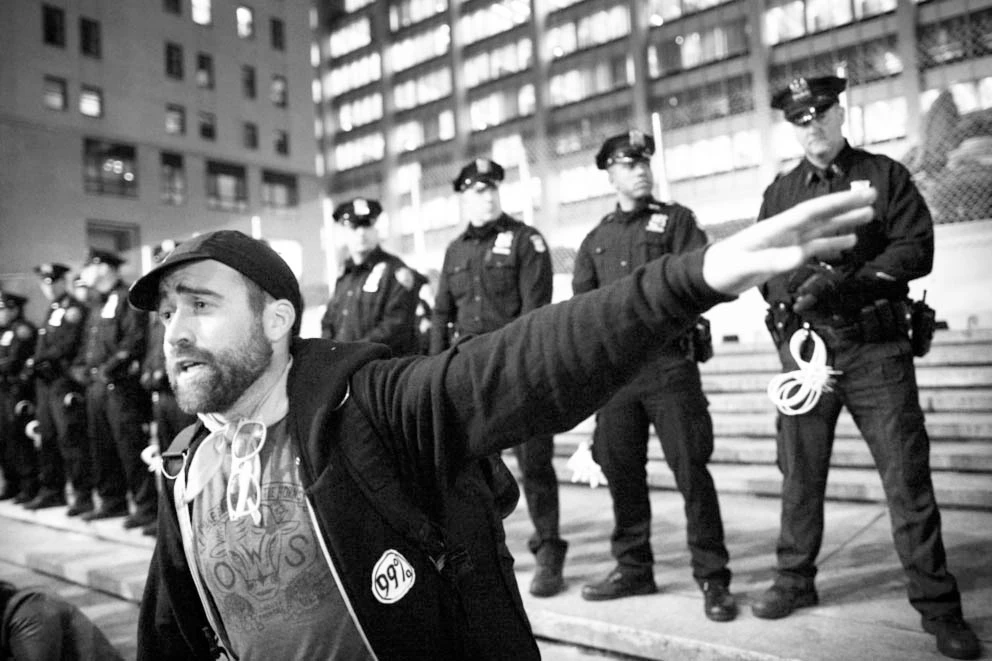
NEW YORK: Seven months after Occupy Wall Street’s eviction from Zuccotti Park, the round-the-clock encampment in lower Manhattan that was once the movement’s center, one protester has created his own version of the communal living experiment in Brooklyn.
The spacious apartment in Crown Heights where Austin Guest, a 31-year-old Harvard University graduate, lives with another seasoned protester is a far cry from the crowded, chaotic Zuccotti Park of last fall, where hundreds of protesters camped out each night.
Nevertheless, inspired by Zuccotti, with its free meals and free books, Guest said he and his friends are pursuing an Occupy-like experiment in mutual aid.
In the apartment, for example, the protesters follow a code of conduct designed to prevent one person from dominating a conversation. Guest, who majored in performance and media studies at Harvard, said he has had to “unlearn” the sometimes “impenetrable” rhetoric of the Ivy League. “I was trained to speak in, like, five paragraphs at a time, with really clearly delineated, bulletproof arguments. And that kind of communication doesn’t leave a lot of space. That’s the point. It’s impenetrable. And that’s not how we talk in OWS,” he said.
Guest, a California native with a slight build and a beard who prefers his trademark cap tilted to one side, called the Occupy movement “the best thing that ever happened to me.” It is not clear how many other Occupy Wall Street alumni continue to protest in New York on a full-time basis. Several hundred protesters packed into Times Square on May 15 as part of a coordinated action timed to JPMorgan Chase’s shareholder meeting. Several dozen people regularly congregate in Union Square, especially on Friday nights. And there are several communal-living arrangements in Brooklyn.
At the same time, an analysis by Reuters earlier this month found that donations have slowed to a trickle, while the movement’s social media popularity, a key indicator of its strength, has fizzled since its zenith last fall.
“We’re finding less people living in tents, but we’re finding more people sitting around kitchen tables, and more people meeting up in cafes,” said Ed Needham, a spokesman for Occupy Wall Street. “There’s an awful lot of decentralized organization going on.” Guest, who is white, moved to the predominantly black neighborhood of Crown Heights on June 1. He and another protester, Marisa Holmes, split the $1,400 monthly rent while they look for a third roommate to lower their costs. A number of other Occupiers come and go but don’t pay rent.
“In my opinion, most of the people who were occupying Wall Street were upstanding people,” said Johnnie Godette, who works for a local education organization called Foundations for Life. “Them coming here to move and diversify the neighborhood is definitely a good thing.” Several times a week, Guest bicycles to wealthier Brooklyn neighborhoods, like Park Slope and Cobble Hill, where he and other protesters help themselves to the bread and vegetables that gourmet shops deem spoiled or unfit for sale.
For one protester, ‘Occupy Wall Street’ becomes a way of life