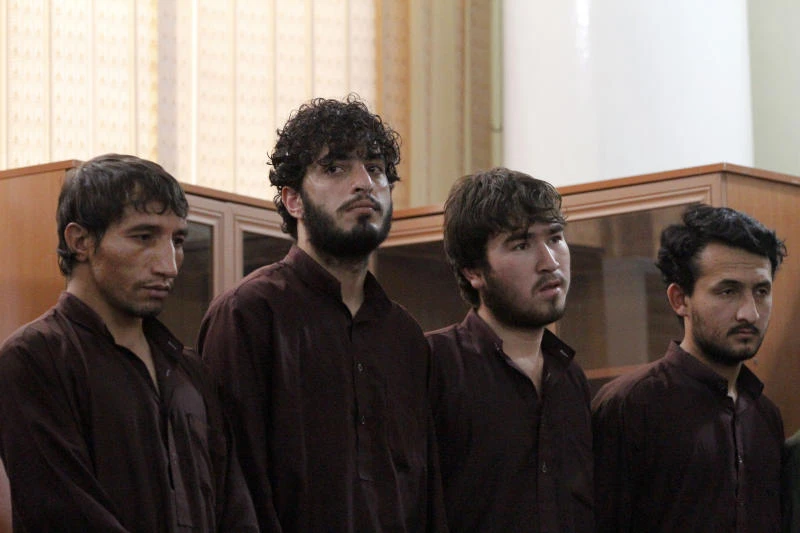
KABUL: Four Afghan men were sentenced to death Wednesday for the savage lynching of a woman falsely accused of blasphemy, a landmark judgment in a nation where female victims often have little legal recourse.
The Kabul primary court also sentenced eight people to 16 years in prison while 18 others were found not guilty after a three-day trial broadcast live on national television.
A furious mob turned on 27-year-old Farkhunda on March 19, beating her in broad daylight and setting her body ablaze on the banks of the Kabul River.
The attack came after an amulet seller, whom she had reportedly castigated for peddling superstition, falsely accused her of burning the Qur’an.
Her killing triggered protests around Afghanistan and drew global attention to the treatment of Afghan women.
Forty-nine people were arrested, including 19 police officers, some of whom were shown standing by and doing nothing to stop the mob in cellphone videos recorded by bystanders.
The trial, which drew praise for its fast-track nature but also prompted concern over its fairness, saw the suspects facing various charges including assault, murder and inciting others to participate.
Judge Safiullah Mojaddidi, announcing the verdict, said Zainul Abiddin, Mohammad Yaqub, Mohammad Sharif and Abdul Bashir would be hanged.
“It is not a final decision and their right to appeal is reserved,” the judge said.
Farkhunda’s parents, who were in court on Wednesday, said before the verdict was announced that they “only want justice, nothing else.”
Her brother Mujibullah said his family was not happy with the large number of acquittals in a murder caught on cellphone cameras and circulated on social media.
There were dozens and dozens of people “involved in killing of my sister and the court only sentenced four to death,” he said.
“We want the court... to bring more perpetrators to justice.”
Human Rights Watch said it was “very concerned” over whether due process was followed in the swift trial in which many of the accused did not appear to have lawyers.
“To reach a verdict against 30 defendants on such serious charges in... days, on its face raises serious due process concerns,” said Heather Barr, a senior researcher with the group on women’s rights in Asia.
Thousands flee homes
As many as 10,000 Afghan families have fled their homes as Taleban insurgents and government forces prepared for a major battle for control of the southern fringes of Kunduz city, officials said on Wednesday.
The World Food Programme is preparing food packages for displaced families and expects to start distributing them this weekend.
Afghan security forces and Taleban insurgents backed by foreign jihadists on the outskirts of Kunduz have been in a standoff for nearly a week since the militants launched an offensive on the city late last month.
The Taleban push on Kunduz, about 500 km north of Kabul, is the most serious threat to a provincial capital in years, although government forces insist the city will not fall to the insurgents.
The Afghan army and police are fighting without substantial help from foreign troops, after the NATO military mission ended its combat role at the end of 2014.
Kunduz police spokesman Sayed Sarwar Hussaini said government forces would soon launch a big offensive to drive the Taleban from Gul Tepa district on the southern outskirts of the city.
He said that the army and police had delayed in order to give civilians time to clear out of the area.
“The Taleban inside the surrounding villages want to use them as human shields, so the villagers have escaped to the central parts of the city,” Hussaini said.
More than 10,000 families have officially appealed for aid as refugees of the fighting, said Abdul Salaam Hashemi, the head of Kunduz’s refugee department.
Four sentenced to death in Kabul lynching case