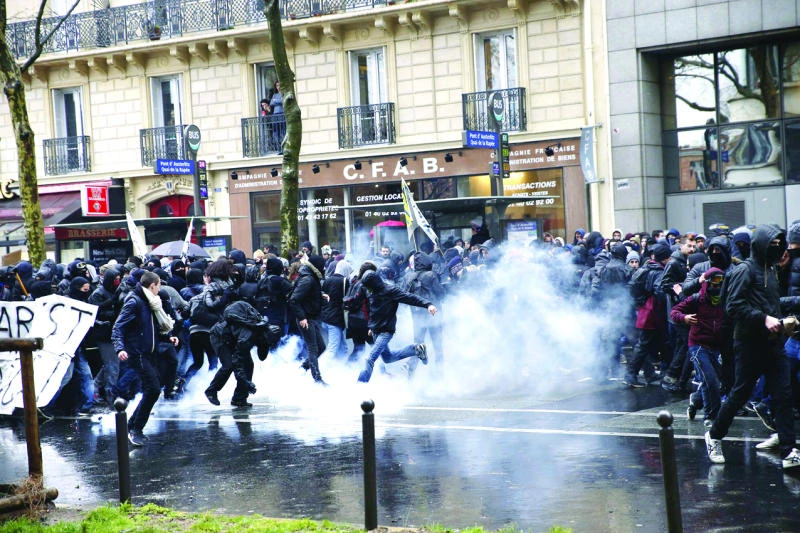
PARIS: Clashes broke out on the streets of France on Thursday during fresh protests over labor reforms, just a day after beleaguered President Francois Hollande was forced into an embarrassing U-turn over constitutional changes.
A nationwide strike shut the Eiffel Tower and disrupted train services after transport staff stopped work and took to the streets along with high-school students to challenge plans for a pro-business loosening of the country’s protective labor laws.
Riot police flooded the streets and clashed with protesters in the western cities of Nantes and Rennes, among 200 demonstrations expected across the country.
Police said around 10 people had been arrested in the capital, where demonstrators marched under banners reading “We want better” and “A giant leap forward to the 19th century.”
Adding to Hollande’s miserable week, a separate strike by air traffic controllers threatened travel chaos for thousands of passengers, while drivers faced more than 400 km of tailbacks on motorways around Paris.
The Socialist government is desperate to push through reforms to France’s controversial labor laws, billed as a last-gasp attempt to boost the flailing economy before next year’s presidential election.
But protests by unions and students turned violent last week and demonstrators vowed an even bigger turnout on Thursday.
They are angry over plans to make it easier for struggling companies to fire workers, even though the reforms have already been diluted once in a bid to placate employers.
Already the least popular president in France’s modern history, Hollande is seeing his numbers continue to fall, with another poll on Wednesday showing he would not even make it to the second-round run-off in the presidential election.
Hollande, 61, has vowed not to run again if he cannot cut the country’s stubbornly high unemployment figures — long stuck at around 10 percent — and he hoped the labor reforms would encourage firms to hire more staff.
But pressure from the street and parliament’s back benches caused the government to water down the proposals so that they apply only to large firms.
Some reform-minded unions have given their support to the changes, but last week’s demonstrations saw cars burned in Paris and more than 30 people arrested as protesters clashed with police, who responded with tear gas.
A video of an officer punching a 15-year-old boy on the sidelines of a protest in the capital went viral and fueled further anger.
The officer was taken into custody and questioned on Thursday, police and judicial sources said.
A recent opinion poll found that 58 percent of the French public still opposed the measures.
Labour Minister Myriam El Khomri said this week that she understood why “such a profoundly reformist text has raised questions and requires debate,” adding: “It is not a blank cheque for companies.”
Bosses are also unhappy, particularly over the removal of a cap on compensation paid for unfair dismissal, and the scrapping of plans that would have allowed small- and medium-sized companies to unilaterally introduce flexible working hours.
Parliament is set to vote on the reforms in late April or early May.
The day of protest, the fourth in a month, has been billed by local media as a make-or-break test of strength for President Francois Hollande, plagued by low popularity and a jobless rate stuck stubbornly above 10 percent as mid-2017 elections loom.
The three protests to date have been low-key by the standards of past French strikes, but organizers hope to mobilize more people this time.
France’s SNCF state railway company said stoppages among its staff had cut some services by 40 to 50 percent. About one in five flights were canceled at Orly airport south of Paris, the DGAC air transport authority said.
Under rainy skies, secondary-level school pupils mobilized in Paris and dozens of other cities for protest marches alongside those called by labor unions.
At issue is a proposed overhaul of France’s labor code, a set of regulations bosses claim deters recruitment. Critics say the reforms will lead to worse working conditions and more sackings.
The reforms, due to be debated in parliament next week, would give employers more flexibility to agree in-house deals with employees on working time.
The protests come a day after Hollande, who has said he will not run for re-election if he fails to make a dent in the jobless rate, abandoned another piece of legislation — plans to strip convicted terrorists of French citizenship.
That climbdown was forced on him by other lawmakers, many of them in his own camp.
“When you admit you got it wrong once, it’s possible to say you got it wrong twice ... we’re optimistic. The government needs to say it got it wrong,” said Philippe Martinez, head of the large CGT union.
France faces nationwide protests over labor reforms