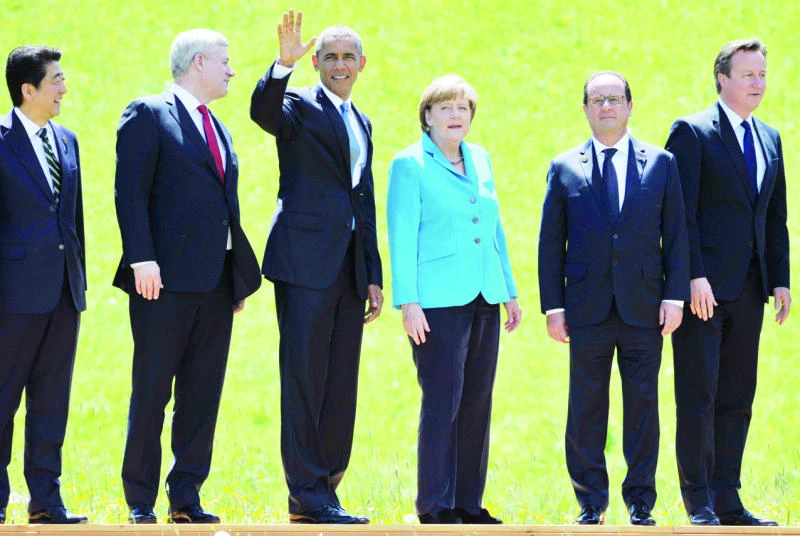
ELMAU CASTLE, GERMANY: The leaders of Germany and the United States hammered home a tough line on Russia Sunday at the start of a G-7 summit dominated by crises in Ukraine and Greece.
German Chancellor Angela Merkel kicked off the day by treating US President Barack Obama to some traditional Bavarian hospitality, with frothy ale, pretzels and oompah brass music played by locals in lederhosen.
But after the smiles in the sunshine, both leaders issued a stark warning to President Vladimir Putin over what Obama said was his “aggression” in Ukraine.
“The two leaders ... agreed that the duration of sanctions should be clearly linked to Russia’s full implementation of the Minsk agreements and respect for Ukraine’s sovereignty,” a statement from the White House said, referring to a cease-fire deal struck in the Belarus capital.
The folksy welcome and display of US-German unity contrasted sharply with the leaders’ line on Russia, which was excluded from the talks.
EU President Donald Tusk, also attending the meeting at the heavily guarded Elmau Castle retreat, said he wanted to “reconfirm G-7 unity on sanctions policy” against Russia, which he said would stay out of the G-7 “community of values” as long as “it behaves aggressively with Ukraine and other countries.”
The Japanese and Canadian leaders had Saturday made a point of visiting Kiev on their way to Germany to voice support for Ukraine’s embattled leaders, as government troops again traded fire with pro-Russian rebels in the east.
A key G-7 issue would be “standing up to Russian aggression in Ukraine,” Obama said ahead of talks with Britain’s David Cameron, France’s Francois Hollande, Italy’s Matteo Renzi, Canada’s Stephen Harper and Japan’s Shinzo Abe.
A recent flare-up in fighting in east Ukraine has left at least 28 dead and sparked fears that the escalation will derail the hard-won cease-fire brokered by France and Germany four months ago.
Obama, without naming crisis-hit Greece, also pointed at the European Union’s ongoing troubles with debt-hit Athens, mentioning as the top summit issues “the global economy that creates jobs and opportunity” and “maintaining a strong and prosperous European Union.”
Merkel — a champion of tough reforms and austerity in return for loans — had made a last-ditch effort to resolve the Greek crisis in the days before the G-7 summit, huddling during the week with the heads of the IMF, European Commission and European Central Bank in Berlin.
Yet the Greek drama threatened to overshadow the G-7 summit, which Merkel has hoped to focus on other pressing global issues — from climate change and Islamist extremism to women’s rights, public health initiatives and the fight against poverty.
Greece’s radical-left government and its creditors have been locked in negotiations for five months in a bid to unlock 7.2 billion euros ($8 billion) in desperately-needed rescue funds.
The European Commission last week presented Greece with a five-page list of proposals, including sales tax hikes and cuts in civil servants’ salaries and pensions.
G-7 summit opens with tough line on Russia