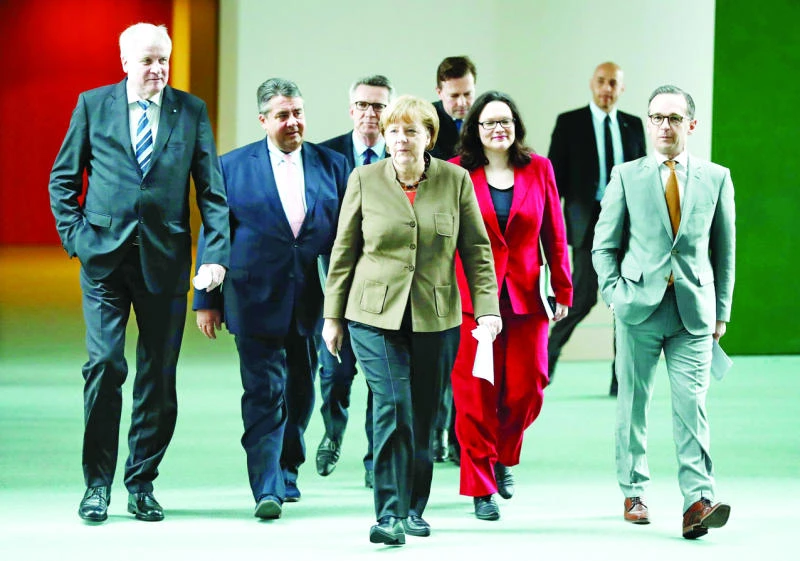
BERLIN: German Chancellor Angela Merkel’s ruling coalition agreed on Thursday on sweeping measures to spur the integration of migrants and refugees in a “historic” first for a country that long resisted embracing immigration.
The deal, hammered out in seven hours of late-night talks between Merkel’s conservative Christian Union bloc and the Social Democrats (SPD), also included plans for new anti-terror legislation.
The integration bill would take a carrot-and-stick approach, providing subsidised courses to help newcomers find their way in German life but, in some cases, denying residence permits to those who fail to take up the offer.
Germany took in more than one million asylum seekers in 2015 and Merkel has faced virulent criticism from skeptics, particularly from within her conservative camp, who argue that Europe’s top economy is ill-equipped to cope with the influx.
She told reporters the measures, “in a first for Germany” would foster the settlement of those who stay in the country in the long run.
“We know, after hundreds of thousands of refugees arrived in our country, that we are facing a two-pronged challenge: On the one hand controlling the flow of refugees... and of course on the other hand not just registering them but integrating them,” Merkel said.
Vice Chancellor Sigmar Gabriel of the SPD called the agreement a “historic step” toward acknowledging the “modernization and opening of our society” and said he hoped it would lead to a broader immigration bill long resisted by conservatives.
“For the first time in the history of the republic, Germany will have its own integration law,” he said, criticizing the neglect the issue suffered in the country over decades.
“The integration of people from very different cultures does not happen on its own, as we were forced to learn based on our experience.”
Beginning in the 1960s, Germany invited Turks and other “guest workers” to fuel its economic miracle but it failed to provide millions of immigrants and their descendants a place in their new society or a path to citizenship.
In recent years, Berlin has looked to immigration as a viable solution to the country’s demographic time-bomb, with a dramatically shrinking native population expected to pose serious problems for Europe’s top economy.
The government’s show of unity Thursday was intended to end months of infighting and breathe life into Merkel’s “We can do it” mantra during the refugee crisis, which she has repeatedly said can also represent an opportunity for Germany.
Meanwhile the closure of the so-called Balkan route taken by many migrants has led to a sharp decline in new arrivals in recent weeks, alleviating some of the political pressure on Merkel.
Under the new pact seen by AFP, federal funds would be used to create 100,000 jobs for asylum seekers receiving benefits.
Germany agrees on ‘historic’ steps to embrace migrants