- More than 100 flights at the city’s airport canceled after aviation authorities warned passengers about potential disruptions
- Key roads were also blockaded causing tailbacks in parts of the already congested city
HONG KONG: At least 100 flights were canceled and subway service widely disrupted in Hong Kong on Monday as a pro-democracy movement called for a general strike.
Cathay Pacific and other domestic carriers such as Hong Kong Airlines were the most affected by the flight cancelations, public broadcaster RTHK said. Airport express train service was also suspended.
A citywide strike and demonstrations in seven districts in Hong Kong have been called for Monday afternoon. They follow a weekend of clashes with police on the streets.
Protesters snarled the morning rush hour by blocking train and platform doors to prevent trains from leaving stations.
Subway and train operator MTR said Monday that service had been partially suspended on five lines because of a number of door obstruction incidents.
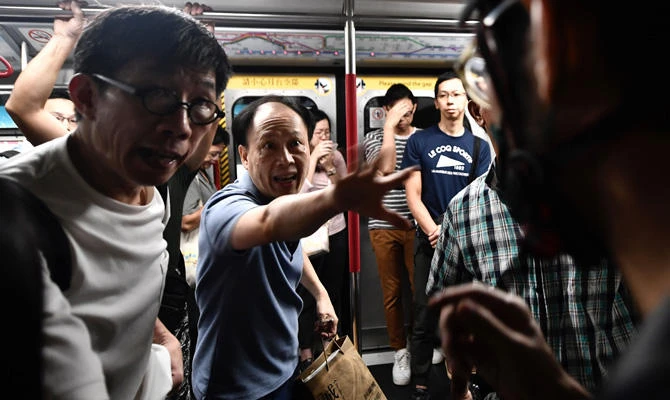
Activists descended on key subway stations during the morning rush hour, deliberately keeping open doors to stop trains departing, causing long queues and triggering occasional scuffles between angry commuters and protesters.
Key roads were also blockaded causing tailbacks in parts of the already congested city.
While some commuters were angered by the morning transport chaos, others said they supported the action after more than two months of extraordinary protests aimed at securing democratic freedoms.
“As long as the government doesn’t respond then for sure the movement will escalate,” a civil servant, who gave his surname as Leung, told AFP as he tried to make his way to work.
“Over the last 50 days, the government has been ignoring the demands of the people and using only police force to try to suppress voices, causing countless Hong Kong people to despair,” the union said in a statement on its Facebook page.
The office of city leader Carrie Lam — who has kept a low public profile as the protests have escalated — announced she would hold a press conference later Monday morning.
Hardening stance
The strike — a rare sight in a freewheeling finance hub where unions traditionally have little sway — is aimed at showing Beijing that there is still broad public support for a protest movement that keeps hitting the streets but has so far won few concessions.
The protests in the semi-autonomous southern Chinese city were triggered by opposition to a planned extradition law but quickly evolved into a wider movement for democratic reform and a halt to eroding freedoms.
But there is little sign on any solution on the horizon as both sides dig in for what increasingly feels like a long war of attrition.
Authorities in Hong Kong and Beijing have signaled a hardening stance with the Chinese military saying it is ready to quell the “intolerable” unrest if requested.
Dozens of protesters have been charged with rioting, a charge with a maximum penalty of 10 years in jail.
Over the weekend riot police fired tear gas at protesters in multiple districts throughout Saturday and Sunday night.
The largely leaderless protest movement uses social messaging apps to coordinate.
At a press conference on Saturday, strike organizers — many hiding their identities behind masks — said 14,000 people from more than 20 sectors had committed to civic action on Monday.
People from all walks of life indicated plans online to either strike or phone in sick on Monday — from civil servants and social workers, to flight attendants, pilots, bus drivers and even employees of the city’s Disneyland.
Notorious gangsters unleashed
In a statement late Sunday, Hong Kong’s government warned people against joining the strike, saying it could further hamper the city’s already sputtering economy.
“Any large-scale strikes and acts of violence will affect the livelihood and economic activities of Hong Kong citizens,” it said.
Alongside the strike, protesters plan to hold rallies in seven different parts of the city, the fourth day in a row that protests have been scheduled.
The past fortnight has seen a surge in violence on both sides with police repeatedly firing rubber bullets and tear gas to disperse increasingly hostile projectile-throwing crowds.
A group of men suspected to be linked to triads — Hong Kong’s notorious gangsters — also attacked demonstrators, putting 45 people in hospital.
Under the terms of the 1997 handover deal with Britain, Hong Kong has rights and liberties unseen on the Chinese mainland, including an independent judiciary and freedom of speech.
But many say those rights are being curtailed, citing the disappearance into mainland custody of dissident booksellers, the disqualification of prominent politicians and the jailing of pro-democracy protest leaders.
Public anger has been compounded by rising inequality and the perception that the city’s distinct language and culture are being threatened by ever-closer integration with the Chinese mainland.
Meanwhile, the city's leader warned Monday as train travel and international flights in the global financial hub were thrown into chaos that Hong Kong's pro-democracy protesters are close to creating a "very dangerous situation".
The peak-hour efforts to lock down Hong Kong's transport sector on Monday morning followed two months of unprecedented and often violent unrest, fuelled by demands for greater democracy in the semi-autonomous Chinese city.
With commuters unable to get to work and international travellers facing delays, chief executive Carrie Lam held a press conference to warn protesters and signal authorities would not buckle under the growing pressure.
"(They) have seriously undermined Hong Kong's law and order and are pushing our city, the city that we all love and many of us helped to build, to the verge of a very dangerous situation," Lam said.
She later referenced called by protesters for a "revolution", describing this as a challenge to the 'one country, two systems' framework under which Hong Kong has been ruled since it returned from British to Chinese rule in 1997.
"I dare say they are trying to destroy Hong Kong," Lam said.
She spoke shortly after activists descended on key subway stations during the morning rush hour, deliberately keeping open doors to stop trains departing, crippling multiple lines and triggering occasional scuffles.
More than 100 flights at the city's airport -- one of the world's busiest -- were also listed as cancelled on Monday morning.
Many disrupted flights were with Cathay Pacific.
The carrier did not give a reason for the cancellations, but its flight attendants union confirmed some of its members had walked out.
"Over the last 50 days, the government has been ignoring the demands of the people and using only police force to try to suppress voices, causing countless Hong Kong people to despair," the union said in a statement on its Facebook page.
Some key roads were also blockaded, causing traffic gridlock, as the protesters urged a general strike across the city.
The largely leaderless protest movement uses social messaging apps to coordinate.
But people from all walks of life indicated plans online to either strike or phone in sick on Monday -- from civil servants and social workers, to bus drivers and even employees of the city's Disneyland.
Many shops across the city were shuttered, including fashion outlets in the central commercial district like Topshop and Zara.
Alongside the strike, protesters planned to hold rallies in seven different parts of the city on Monday.
While some commuters were angered by the disruptions, others said they supported the action.
"As long as the government doesn't respond then for sure the movement will escalate," a civil servant, who gave his surname as Leung, told AFP as he tried to make his way to work.
The efforts for a general strike -- a rare sight in a freewheeling finance hub where unions traditionally have little sway -- is aimed at showing Beijing there is still broad public support for a protest movement that keeps hitting the streets but has so far won few concessions.
"Support for the political strike today seems strong and it's been bolstered further by the escalating violence between the police and protesters," political analyst Dixon Wong told AFP.
The protests were triggered by opposition against a planned law that would have allowed extraditions to mainland China.
It quickly evolved into a wider movement for democratic reform and a halt to eroding freedoms.
Even before Lam's press conference, authorities in Hong Kong and Beijing had signalled a hardening stance to the protests.
The Chinese military described the unrest last week as "intolerable" and released a propaganda video showing a drill of troops quelling a protest in Hong Kong.
Dozens of protesters were also charged with rioting over the past fortnight, a charge with a maximum penalty of 10 years in jail.
Over the weekend riot police fired tear gas at protesters in multiple districts throughout Saturday and Sunday night.
The past fortnight has seen a surge in violence on both sides with police repeatedly firing rubber bullets and tear gas to disperse increasingly hostile projectile-throwing crowds.
A group of men suspected to be linked to triads -- Hong Kong's notorious gangsters -- also attacked demonstrators, putting 45 people in hospital.
Under the terms of the 1997 handover deal with Britain, Hong Kong has rights and liberties unseen on the Chinese mainland, including an independent judiciary and freedom of speech. But many say those rights are being curtailed.