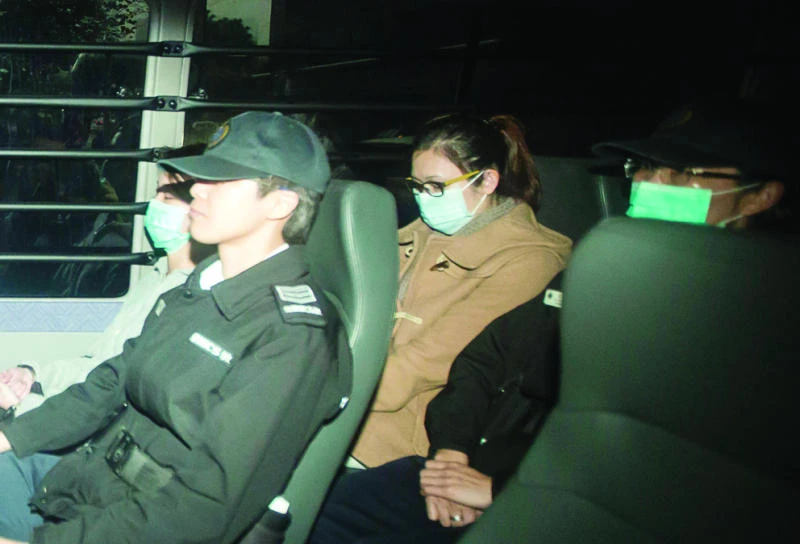
HONG KONG: A Hong Kong woman was jailed for six years on Friday for beating and starving her Indonesian maid and keeping her prisoner, as the judge called for action over laws which leave domestic workers exposed to abuse.
Law Wan-tung was found guilty earlier this month on 18 charges, including assault, grievous bodily harm, criminal intimidation and failure to pay wages or give time off work to Erwiana Sulistyaningsih, 45.
She also had pleaded guilty to one other charge.
Law had no reaction as the sentence was handed down by District Court Judge Amanda Woodcock, who said “the seriousness of the charges and circumstances of the offences means a lengthy prison time is appropriate.”
In addition to prison, the judge also fined Law 15,000 Hong Kong dollars ($1,930).
The case highlighted the vulnerabilities of migrants working as domestic staff across Asia and the Middle East and strained ties with Indonesia, which supplies about half of the 330,000 foreign domestic helpers working in Hong Kong.
But while victim Erwiana Sulistyaningsih said she was happy and “appreciated” the judgement, she felt that six years was not long enough.
“I’m still not satisfied with six years’ imprisonment, because of what she has done to me, and to my fellow domestic workers,” Sulistyaningsih told reporters.
Sulistyaningsih’s case came to light when graphic pictures of her injuries started circulating among Indonesians in Hong Kong, showing her face, hands and legs covered with scabs and lacerations, and blackened, peeling skin around her feet.
Sulistyaningsih worked for Law, who has two teenage children, for about eight months starting in June 2013.
Court heard that Sulistyaningsih suffered broken teeth, scratches all over body and blows to her head at the hands of Law, who also jammed a metal vacuum cleaner tube pushed into her mouth, causing her lip to bleed. Law also forced Sulistyaningsih to stand naked in the bathroom during winter while she splashed water on her and pointed a fan at her.
But while victim Erwiana Sulistyaningsih said she was happy and “appreciated” the judgement, she felt that six years was not long enough.
“I’m still not satisfied with six years’ imprisonment, because of what she has done to me, and to my fellow domestic workers,” Sulistyaningsih told reporters.
Law Wan-tung -- who had faced a maximum sentence of seven years -- “showed no compassion” to Sulistyaningsih and other domestic staff, said judge Amanda Woodcock in handing down the sentence.
Law saw them as “people that are beneath her”, said Woodcock.
“It is regrettable that this conduct is not rare and sadly is often dealt with in the criminal courts,” she added.
The judge called for an investigation by Hong Kong and Indonesian authorities into employment agencies that charge domestic workers huge fees which are then deducted from their salaries.
Of Sulistyaningsih’s treatment, she said: “She was given little rest, sleep and nutrition which left her a shadow of her former self.”
Sulistyaningsih, 24, told a Hong Kong court in December how she lived on meagre rations of bread and rice, slept only four hours a day and was beaten so badly by her employer Law that she was knocked unconscious.
During the six-week trial, prosecutors said mother-of-two Law, 44, turned household items such as a mop, a ruler and a clothes hanger into “weapons” against her maids.
Law was convicted on 18 of 20 charges against her, including grievous bodily harm, assault, criminal intimidation and failure to pay wages.
Maid abuse cases in Asia, Mideast
The Hong Kong woman found guilty of beating and starving her Indonesian maid was sentenced to six years in jail on Friday, in the latest high-profile abuse case of foreign domestic workers working across Asia and the Middle East. Only 12 percent of Asian countries guarantee minimum wages for domestic helpers, a figure that stands at just one percent in the Middle East, according to the International Labor Organization. Under the controversial “kafala” (sponsorship) system that several Arab states enforce, migrant domestic workers are barred from moving to a new job unless they obtain their employer’s consent, trapping many in abusive situations. Below is an overview of recent high-profile cases involving the abuse of migrant domestic workers in Asia and the Middle East, although activists say this represents the tip of the iceberg as most are never prosecuted.
February 2015, Hong Kong
Employer Law Wan-tung is sentenced to six years in jail on charges of grievous bodily harm, assault, criminal intimidation and failure to pay wages to her Indonesian maid Erwiana Sulistyaningsih, 24. Sulistyaningsih told the court during a six-week trial she lived on nothing but meagre rations of bread and rice, slept only four hours a day and was beaten so badly she was knocked unconscious. In a 2013 survey of more than 3,000 foreign domestic workers in Hong Kong, nearly a fifth said they had experienced some form of physical abuse, while 58 percent said they had endured verbal abuse. Six percent said they had suffered sexual abuse.
February 2015, Kuwait
A Kuwaiti criminal court sentences a local man to 10 years in prison for beating his maid to death, according to media reports. Critics have long called for greater recourse to justice for the Gulf’s estimated 2.4 million domestic workers, where most are excluded from protections afforded to other workers.
March 2014, Malaysia
A Malaysian couple are sentenced to hang for starving their Indonesian maid to death. The 26-year-old woman weighed barely 26 kilos when she was taken to hospital with bruises and scratch marks on her back, arms and forehead. Malaysia has taken some steps towards improving the welfare of maids, mostly from neighbouring Indonesia, including giving them at least one day off a week and nearly doubling minimum monthly salaries to 700 ringgit ($210). However, activists say the new rules are not adequately enforced.
May 2013, Malaysia
A Malaysian couple are sentenced to 24 years in jail for starving their Cambodian maid to death in the northern state of Penang. Police said the 23-year-old woman died from acute gastritis and ulcers likely caused by lack of food over a long period. She had been working for the family for eight months.
August 2013, Singapore
A Singaporean woman is jailed for 21 months for punching her 25-year-old maid in the eye, pushing her head against the edge of a toilet doorway and kicking her in the groin. Chan Huey Fern also kicked her maid repeatedly when she found her son’s blanket on the floor in the children’s room. More than 200,000 women, many of them from impoverished villages in Indonesia, the Philippines, India, Myanmar and Bangladesh, work as domestic helpers in affluent Singapore.
November 2013, Kuwait
Kuwait’s supreme court upholds a death sentence against a woman for murdering her Filipina maid after torturing her. The employer was convicted of premeditated murder based on evidence that she had regularly tortured the maid before driving over her in a remote desert area.
March 2012, Lebanon
An Ethiopian domestic worker who was filmed being physically abused in public by her male Lebanese employer commits suicide. Alem Dechasa, 34, hanged herself with a bed sheet at a psychiatric hospital east of Beirut, where she had been taken by police after the February beating that was aired on Lebanese TV. UN human rights experts called on the Lebanese government at the time to enact legislation to protect the 200,000 domestic workers in the country.
January 2011, Malaysia
A Malaysian woman is sentenced to eight years in jail after appealing a lighter sentence for abusing her Indonesian maid. Hau Yuan Tyng was convicted of inflicting horrific wounds on her domestic helper Siti Hajar, using a hammer, scissors and scalding water, before the maid eventually escaped.
September 2010, Saudi Arabia
The Philippines demands that Saudi Arabia investigate the killing of a Filipina domestic worker who was left with horrific injuries after being stabbed and attacked with sulphuric acid at her employer’s home. Human Rights Watch said in 2014 that Saudi Arabian and Qatari employers “refused to pay wages, return passports, or provide permission for ‘exit permits’ in order to exact work from workers involuntarily.”
Hong Kong woman jailed for maid abuse