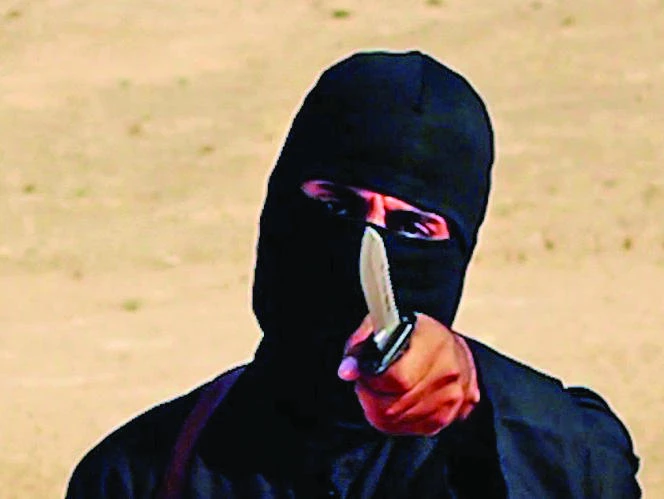
NEW YORK: Daesh has acknowledged the death of the masked militant known as “Jihadi John,” who appeared in several videos depicting the beheadings of western hostages, the SITE Intelligence Group reported Tuesday.
SITE, which monitors terrorist activity, reported that Daesh published a “eulogizing profile” of Jihadi John in its English-language magazine Dabiq on Tuesday. Jihadi John had been identified by the US military as Mohammed Emwazi, a Kuwaiti-born British citizen.
“His harshness toward the kuffar (disbelievers) was manifested through deeds that enraged all the nations, religions, and factions of kufr, the entire world bearing witness to this,” the Dabiq article said, according to a translation provided by SITE.
Army Col. Steve Warren, a US military spokesman, said in November that the Army was “reasonably certain” that a drone strike in Syria had killed Emwazi, who spoke in beheading videos with a British accent as he wielded a knife.
Separately, a US official said three drones — two US and one British — targeted the vehicle in which Emwazi was believed to be traveling in Raqqa, the capital of the Daesh’s self-proclaimed caliphate in northern Syria. The official said the US drone fired a Hellfire missile that struck the vehicle.
“Jihadi John” appeared in videos posted online by the Daesh starting in August 2014 that depicted the beheadings of US journalists Steven Sotloff and James Foley, US aid worker Abdul-Rahman Kassig, British aid workers David Haines and Alan Henning, and Japanese journalist Kenji Goto.
In the gruesome videos, a tall masked figure clad in black and speaking in a British accent typically began with a political rant taunting the West and a kneeling hostage clad in an orange prison-style jumpsuit before him, then ended it holding an oversize knife in his hand with the headless victim lying before him in the sand. The videos don’t make clear if he carried out the actual killings.
He also appeared as a narrator in videos of other beheadings, including the mass killing of captive Syrian government soldiers.
Emwazi was believed to be in his mid-20s when he was killed. He had been described by a former hostage as a psychopath who enjoyed threatening his Western captives.
Spanish journalist Javier Espinosa, who was held by the Daesh in Syria for more than six months after his abduction in September 2013, said Emwazi would explain precisely how the militants would carry out a beheading.
The hostages nicknamed three British-sounding captors “the Beatles,” with “Jihadi John” a reference to John Lennon, Espinosa said.
It’s official: ‘Jihadi John’ is dead