- Britain’s existing strategy is no longer “adequate” to protect the 300,000 British nationals living in the region, he warned
LONDON: A life peer in the UK’s House of Lords has called on the government to review its decision to not list Yemen’s Houthi militia as a terrorist organization after a devastating attack on Riyadh’s King Khalid International Airport left three dead and dozens more injured.
Lord Sarfraz, a Conservative life peer in the UK, described Thursday’s Houthi missile attack as a “tipping point” in his decision to file a letter with the UK security minister today.
Britain’s existing strategy is no longer “adequate” to protect the 300,000 British nationals living in the region, he warned.
“It is not just assets that this group is attacking; there are hundreds of thousands of British nationals living in the region, and the attack on the airport — which left three people dead — has shown the Houthis’ willingness to attack civilian targets,” Lord Sarfraz told Arab News.
“My reason for acting on this now is because, personally, attacking Riyadh’s airport was a tipping point; it is different to attacks on commercial shipping and it reinforces the serious nature of the threat to both our people in the region, and to everyone else living there.”
In his formal letter to UK Security Minister Dan Jarvis today, seen by Arab News, Lord Sarfraz warned that a resumption of Red Sea attacks by the Houthis poses a “direct threat to British trade, maritime security and regional stability.”
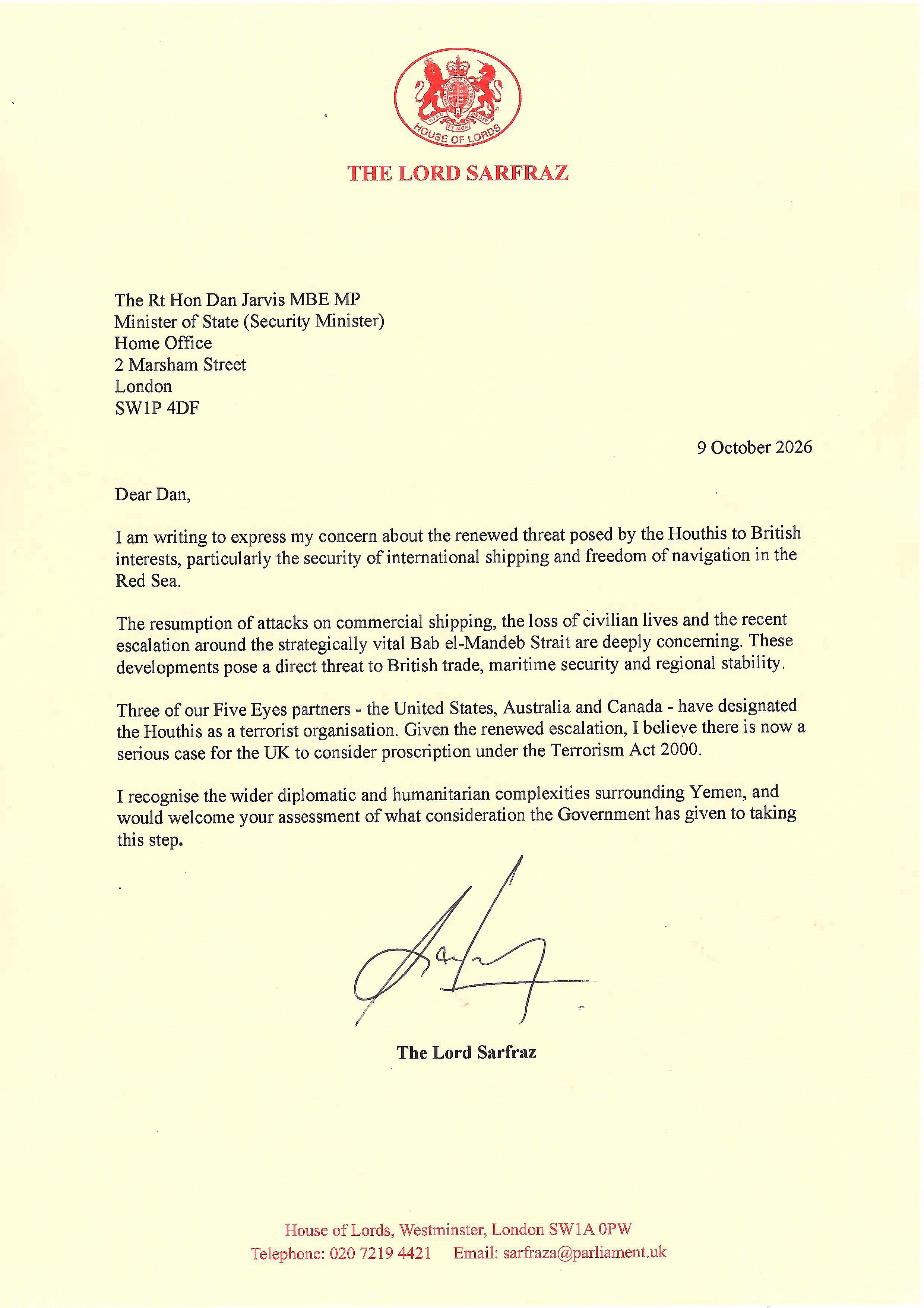
Highlighting a growing gap between the UK and its closest security allies, he noted that three of the country’s Five Eyes security partners, Australia, Canada and the US, had already designated the Houthis as a terrorist organization.
“Given the renewed escalation, I believe there is now a serious case for the UK to consider proscription under the Terrorism Act 2000,” Lord Sarfraz wrote, describing loss of civilian lives and escalation in the strategically vital Bab Al-Mandab Strait as “deeply concerning.”
Should Westminster proscribe the militia, UK law enforcement would be afforded sweeping powers to freeze assets, disrupt domestic financial pipelines and criminalize anyone within the UK found to be fundraising, promoting or showing support for the group.
Government reticence to proscribe the Houthis is largely due the group’s control over large swathes of Yemen and the lack of a clear carve-out for humanitarian work in the Terrorism Act. Proscription could place aid groups active in Yemen at risk of prosecution.
Highlighting Yemen’s “worsening humanitarian crisis,” which has displaced more than 200,000 people, Lord Sarfraz suggested that proscription could prove the “firmer line” necessary for bringing “folks to the table.”
Describing this as “the moment,” Lord Sarfraz told Arab News that “discussions will have to happen at some point; they have happened in the past, and I think taking a firmer, non-military stance, could be helpful for moving us to this.”
Declining to comment on Lord Sarfraz’s request, a spokesperson for the Home Office told Arab News that the government keeps the list of proscribed organizations under close review and that it condemned the Houthi resumption of violence in Yemen and attacks on Saudi Arabia.
Among those killed in Thursday’s double-strike missile attack was pilot Captain Hamoud Ali Al-Kalthami of the Saudi flag carrier, Saudia. It marked the third targeting of the airport this week by the Iran-backed militia.
During an attack that took place between Tuesday and Wednesday, a Sudanese international was killed, while a separate attack on Tuesday against Abha International Airport left one Moroccan and an Algerian dead.