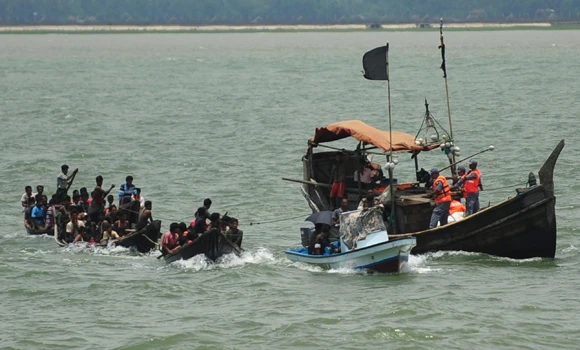
SITTWE, Myanmar: Myanmar pledged yesterday to hunt down those responsible for the deaths of 50 people in communal clashes, as the relief effort was stepped up for tens of thousands displaced by the violence.
More than 30,000 people — both ethnic Rakhine Buddhists and Muslim Rohingya — have been displaced after homes were set ablaze during riots and revenge attacks in the western state of Rakhine earlier this month, state media says.
The UN warned of the “immense hardship” faced by thousands of families, just as monsoon rains sweep in. Rice, water and shelter is being delivered to the state capital Sittwe, but there are mounting concerns about more remote areas.
Both sides accuse each other of being responsible for the violence, which has torn apart communities that had lived together for many years and overshadowed recent reforms under the quasi-civilian government.
After visiting the area, a senior Myanmar minister vowed the government “would bring about justice and prosecute offenders without bias,” state mouthpiece the New Light of Myanmar reported Sunday.
“Lawlessness is unacceptable,” the paper said, quoting Lt. Gen. Thein Htay, Union Minister for Border Affairs and Myanmar Industrial Development.
“The government will bring offenders to justice and restore stability as soon as possible,” he vowed.
The unrest has prompted President Thein Sein to warn of the danger of disrupting the nation’s fledgling reform process as Myanmar emerges from decades of military rule.
But in Sittwe more immediate concerns dominate, with the United Nations estimating around 10,000 people are badly in need of temporary shelter and food following several days of violence.
The military has been joined by non-governmental organizations and local donors in providing food, water and shelter, a Rakhine official said, as thousands spent another night in tents after fleeing their burning homes.
“Food is being distributed to the displaced people,” Thar Lu Chay, a Rakhine minister, said in Sittwe, adding that the UN’s refugee arm is among those “providing bags of rice to the people.” But there are fears insufficient relief has reached remote areas, particularly with the monsoon rains threatening Rakhine, where an uneasy calm was reported in Sittwe, with military and police enforcing a curfew overnight.
Decades of discrimination have left the Muslim Rohingya stateless and viewed by the United Nations as among the most persecuted minorities on the planet. About 800,000 of them live in Myanmar, according to the UN, mostly in Rakhine.
The Myanmar government considers the Rohingya to be foreigners, while many citizens see them as illegal immigrants from Bangladesh and view them with hostility.
A Rohingya Muslim died in a Bangladesh hospital yesterday, police in Chittagong said, the second refugee fleeing violence in neighboring Myanmar to do so after allegedly being shot by security forces.
Political prisoners
Myanmar’s government is planning to free more political prisoners as early as next month, a minister said yesterday in Norway, where democracy leader Aung San Suu Kyi was on a four-day visit.
Speaking on the sidelines of an Oslo conference that was addressed by Suu Kyi, the minister also stressed that the government of President Thein Sein was as committed to democracy as the Nobel Peace Prize laureate.
“We also move to the road to democracy,” said Industry Minister U Soe Thane. “We’re going in the same direction — tactically different, strategically right, on the same track, in the same boat.” On Suu Kyi’s hero welcome in Europe — where she is on a five-nation tour after many years of house arrest and isolation — he said: “I am proud of that, proud of her. A Myanmar lady in Europe, it’s a good thing.”
Asked about Suu Kyi’s call at her Nobel lecture last Saturday to free remaining political prisoners jailed under the former junta, he said: “You better look in July. Maybe, maybe. I’m not the decision-maker.” He explained that the government was now reviewing cases to ensure no-one guilty of a violent crime is released.
“We have the idea to release the rest of the people. An idea, not an order... It’s an ongoing process,” he said.
On the economy, he said the government shared Suu Kyi’s position that future foreign investment, as Western sanctions are being rolled back, must be made in an ethical, sustainable and transparent way.
“A rush is OK, but not a gold rush,” he said.