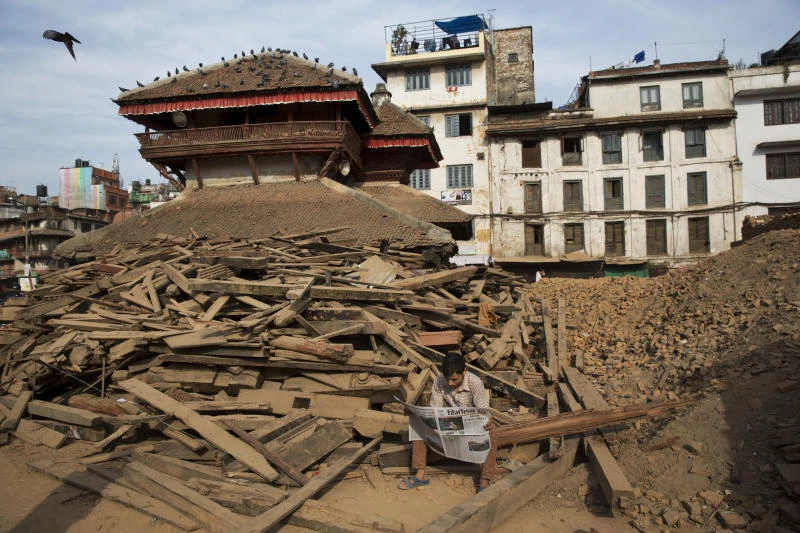
Katmandu/NEW DELHI: A row has broken out between Nepal and some international agencies over the handling of aid that poured into the country after last month’s devastating earthquake, with each side blaming the other for confusion and delays in getting help to victims.
Relief efforts have been slow to reach many people affected by Nepal’s worst disaster in more than 80 years, leaving an unknown number of people stranded, injured and hungry for days.
The 7.8 magnitude quake, which struck 10 days ago, has killed more than 7,500 people and left hundreds of thousands homeless.
Relief material initially piled up at the airport as Nepalese customs officials checked each crate that came in so commercial goods did not slip through.
Senior government officials said customs checks were necessary, because they did not know what was coming into the country.
Supplies included goods that Nepal did not need and many relief workers arrived without proper documents to enter the country, complicating efforts to move the aid effort along, officials said.
“Many donors are sending relief materials without even consulting us about what we need,” said Laxmi Prasad Dhakal, a home ministry official.
Some rescue workers, for their part, said they were frustrated by what they saw as bureaucratic delays and lack of coordination by the government.
For example, Huijbrechts Marcel, from the Urban Search and Rescue team from the Netherlands, showed up along with teams from four other nations, including the Nepal army, at one house to search for survivors.
“When we arrived here there was absolutely no coordination,” Marcel said.
Frustrated by delays and a lack of coordination, some donors are circumventing the government and sending aid directly through non-governmental organizations for distribution, adding to disagreements, said an aide to Prime Minister Sushil Koirala.
“There are differences between the government and some donors over this,” the aide said.
The confusion came despite years of preparation by the government and international aid agencies for such a disaster; Nepal sits atop one of the world’s most seismically active zones.
Nepal’s Foreign Minister, Mahendra Bahadur Pandey, who addressed an international conference in Japan just weeks ago on a possible earthquake in Nepal, said the help from donors was welcome, though not always smooth.
For example, he said, the government had made an error by urgently requesting tents for Nepalis who had lost their homes.
“When donors sent them, they were huge and heavy. What we really want are tarpaulins,” he said.
Meanwhile. rescuers were digging Tuesday through thousands of tons of earth from a quake-triggered mudslide in Nepal that wiped out an entire village along a popular Himalayan trekking route and killed at least 60 people.
Nine of the victims recovered in the Langtang Valley since the April 25 earthquake and mudslide were foreign trekkers, said Gautam Rimal, the top government official in the Rasuwa district. Villagers say as many as 200 people could have been killed.
The valley and its little village of Langtang are about 60 km (35 miles) north of Nepal’s capital, Katmandu. It was a popular stop for trekkers because of its scenic views of the Himalayas.
“The entire village was wiped out by the mudslide. There were some 60 houses there, but they were all buried under rubble. It will be impossible to recover all the bodies,” Rimal said.
The village is now about a two-day hike from the nearest town because the landslide has blocked area roads. While helicopters allow easy access, they remain in short supply because of aid missions across the quake-affected parts of Nepal.
In Katmandu, authorities say up to one-third of the city’s residents have left since the quake. In the first days, bus stations were jammed with people fearing aftershocks or trying to get home to relatives in devastated villages.
Authorities do not know how many of those people have returned to the capital, but on Tuesday there were still people waiting for buses to leave.
“I stayed back here to help out my neighbors and clean up the neighborhood,” said Surya Singh, who was at a large bus station. But now he wants to see the damage in his home village — though with many roads still blocked by landslides he was unsure if he could get all the way by bus.
Katmandu police say nearly 900,000 people have left in the past 10 days.
Nepal, aid agencies trade blame as confusion mars quake relief