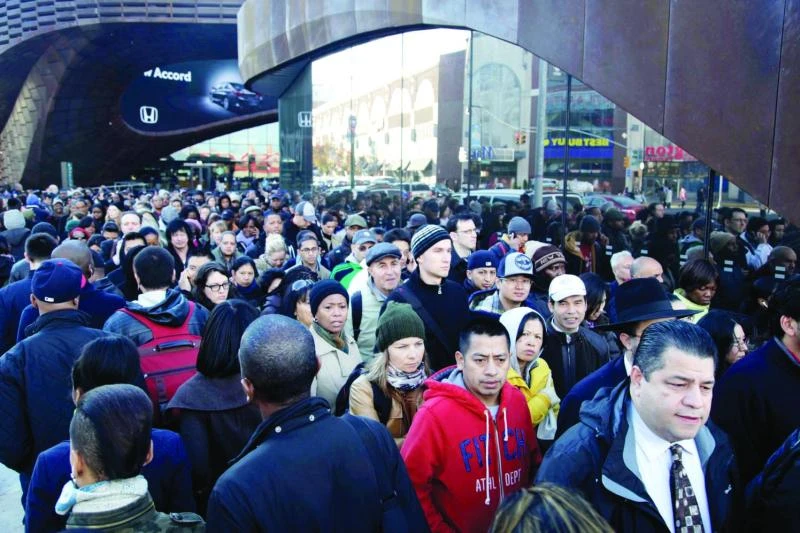
NEW YORK: New York City moved closer to resuming its frenetic pace by getting back its vital subways yesterday, three days after a superstorm, but neighboring New Jersey was stunned by coastal devastation and the news of thousands of people in one city still stranded by increasingly fetid flood waters.
The decision to reopen undamaged parts of the United States’ largest transit system came as the death toll reached more than 70 in the US and left more than 5 million without power. Hurricane Sandy earlier left another at least 69 people dead as it swept through the Caribbean.
In New York, people streamed into the city as service began to resume on commuter train and subway. The three major airports resumed at least limited service, and the New York Stock Exchange was open again. Amtrak’s Northeast Corridor — the busiest train line in the country — was to take commuters along the heavily populated East Coast again starting Friday.
But hundreds of thousands in New York City alone were still without power, especially in Lower Manhattan, which remained in the dark roughly south of the Empire State Building after floodwaters had knocked out power.
Concerns rose over the elderly and poor all but trapped on upper floors of housing complexes in the powerless area, who faced pitch-black hallways, elevators and dwindling food. New York’s governor ordered food deliveries to help them.
In New Jersey, the once-pristine Atlantic coastline famous for the TV show “Jersey Shore” was shattered. President Barack Obama joined Gov. Chris Christie in a helicopter tour of the devastation Wednesday and told evacuees, “We are here for you. We are not going to tolerate red tape. We are not going to tolerate bureaucracy.”
Global warming issue
And warnings rose again about global warming and the prospect of more such severe weather to come.
“The next 50 to 100 years are going to be very different than what we’ve seen in the past 50 years,” said S. Jeffress Williams, a scientist emeritus at the US Geological Survey’s Woods Hole Science Center in Massachusetts. The sea level is rising fast, and destructive storms are occurring more frequently, said Williams, who expects things to get even worse.
Across the Hudson River from New York City, the floodwaters remained in the city of Hoboken, where an estimated 20,000 people remained in their homes amid accusations that officials were slow to deliver food and water. One man blew up an air mattress and floated to City Hall, demanding to know why supplies hadn’t arrived.
NYC back on track as toll rises