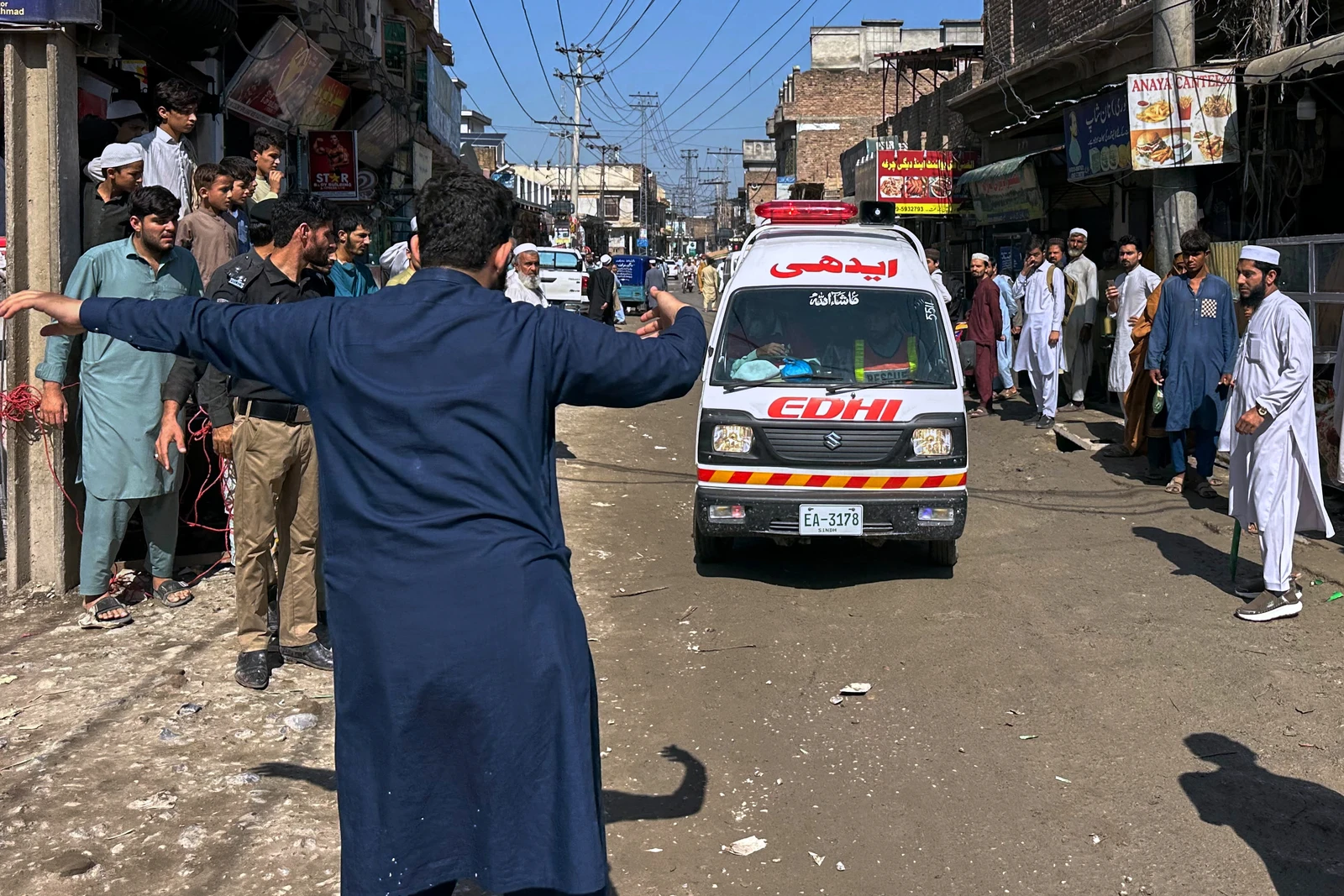
SHIKARPUR: Prime Minister Nawaz Sharif said on Saturday the whole nation was in mourning after Friday’s bombing that killed over 60 people in Shikarpur. He said the government was resolved to stop terrorism.
Pakistan “will win the war against terrorism at any cost,” he told a crowd of almost 1,000 counter-terrorism officers in eastern Lahore city on Saturday.
Thousands of Pakistanis protested on Saturday against the killing.
The blast hit the mosque in the Shikarpur district of southern Sindh province as hundreds of worshippers attended Friday prayers.
Police on Saturday said the devastating explosion was a suicide attack and the bomber detonated the explosives strapped to his body “in the middle of the mosque.”
“The bomber selected a place in the mosque that would cause huge destruction,” Raja Umar Khitab, a police official in Sindh’s counter-terror department, told AFP on Saturday.
Khitab said the bomb was loaded with steel pellets, ball bearings and other shrapnel to cause maximum damage.
The provincial government announced a day of mourning on Saturday, closing schools, shops and offices, with no public transport available on the roads.
In Shikarpur, thousands gathered to attend funeral prayers for the dead.
Karachi, Pakistan’s economic heart and Sindh’s provincial capital, also shut down for the day, with hundreds of Shiites staging protest rallies. Police said unidentified “miscreants” had set fire to a passenger bus and a truck in the city early in the day, but no one was hurt.
Pakistan has suffered a rising tide of sectarian violence in recent years.
Friday’s bombing was the bloodiest single sectarian attack in Pakistan since March 2013, when a car bomb in a Shiite neighborhood of Karachi killed 45.
A spokesman for the shadowy Jandullah militant group, a splinter faction of the Pakistani Taleban, said they were behind the latest blast.
Sectarian attacks have been increasing in recent years in Karachi and also in the southwestern city of Quetta, the northwestern area of Parachinar and the far northeastern town of Gilgit.
Around 1,000 people have been killed in the past two years in Pakistan, with many of the attacks claimed by Lashkar-e-Jhangvi (LeJ) militant outfit.
Pakistan has stepped up its fight against militants in the past month, following a Taleban massacre at a school in the northwestern city of Peshawar.
Heavily armed gunmen went from room to room at the army-run school gunning down 150 people, most of them children, in an attack that horrified the world.
Since then, the government has ended a six-year moratorium on executions in terror-related cases and pledged to crack down on all militant groups.
Arab News