KATMANDU: Nepal’s ruling coalition on Sunday took a step toward drafting a new constitution, angering the opposition and pushing the Himalayan country further into political turmoil.
The parliamentary speaker announced plans for a vote on a new national constitution to end a political deadlock, sparking fresh outrage from opposition lawmakers.
The country’s ruling and opposition parties have spent years locked in a stalemate over the charter and lawmakers missed a Thursday midnight deadline to approve the charter after coming to blows in Parliament.
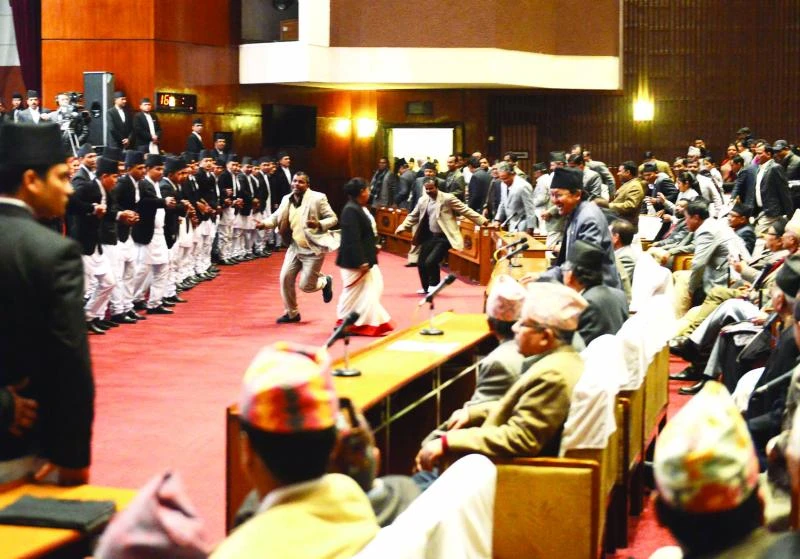
Opposition members in the Constituent Assembly protested noisily behind rows of security personnel in Parliament as Speaker Subash Nemwang ignored them and announced a proposal committee would proceed with voting on the constitution.
The committee is backed by the governing parties’ overwhelming majority, but the opposition parties are demanding the draft of the constitution be prepared by consensus.
Earlier attempts to announce the committee were blocked by protests, including one Tuesday in which opposition assembly members broke chairs and desks and threw microphones and shoes at the speaker.
The opposition parties reacted immediately to Sunday’s announcement, vowing street protests against the speaker and the government. A general strike last week shut down businesses and schools and several vehicles were torched.
“The speaker and the ruling coalition have just pushed the country into a new conflict. We will go back to the people and protest,” said Pushpa Kamal Dahal of the Unified Communist Party of Nepal Maoist, who is leading the opposition alliance.
The committee announced by Nemwang would list the number of issues with disagreements and then vote in the assembly to decide.
The ruling coalition makes up more than two-thirds of the 605-member Constituent Assembly and could easily get their own proposals approved.
A constitution was supposed to have been written by the Constituent Assembly that was elected in 2008 following the end of a 10-year Maoist insurgency and the overthrow of the centuries-old monarchy. But the assembly was riven by infighting and never finished its work. The current assembly was chosen in 2013, but has faced the same problem.
Speaker Subhash Nembang said he had decided to press ahead with a vote rather than wait for an agreement with opposition lawmakers led by former Maoist rebels.
“I have tried to find a middle way that allows...the constituent assembly to move forward, as well as (time to) continue discussions for consensus,” Nembang said.
“Taking all things in consideration, I am taking this action,” Nembang said of the vote, for which no date has yet been set.
Angry opposition lawmakers chanted slogans against Sunday’s motion for a vote, with Maoist chief Pushpa Kamal Dahal, known better as Prachanda, branding it a “huge mistake.”
“We will struggle and resist until the end,” Prachanda told reporters after the motion was passed by ruling lawmakers and their allies, who hold a majority in the parliament.
The former insurgents have warned of further conflict if they fail to take opposition views into account.
A key sticking point concerns internal borders, with the opposition pushing for provinces to be created along lines that could favour historically marginalised communities.
Other parties have attacked this model, calling it too divisive and a threat to national unity.
The constitution was intended to conclude a peace process begun in 2006 when Maoist guerrillas entered politics, ending a decade-long insurgency that left an estimated 16,000 people dead.
But six prime ministers and two elections later, political infighting has confounded efforts to hammer out a deal, throwing Parliament into disarray and crippling the economy.
Anger has spilled over on to the streets, with authorities boosting security inside and outside parliament in recent days.
Opposition lawmakers last week also sparked chaos by storming into the well of the main chamber in a bid to derail the push for a vote and pressure the ruling coalition to return to the negotiating table.
“We have deployed 350 security staff in parliament and 500 more outside. We have also tightened checks at the building’s gates and doors,” said Hemanta Pal, Katmandu police spokesman.
Political tussles thrust Nepal deeper into turmoil