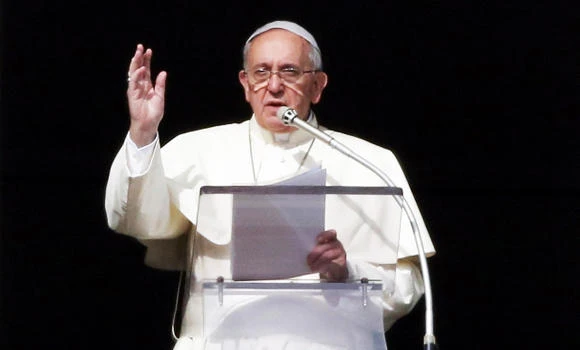
VATICAN CITY: Pope Francis put his first stamp on the group at the top of the Roman Catholic hierarchy on Sunday, naming 19 new cardinals from around the world and emphasising his concern for poor countries.
Sixteen of them are “cardinal electors” under 80 and thus eligible to enter a conclave to elect a pope. They come from Italy, Germany, Britain, Nicaragua, Canada, Ivory Coast, Brazil, Argentina, South Korea, Chile, Burkina Faso, the Philippines and Haiti.
Half of them are non-Europeans, indicating the importance Francis attaches to the developing world. Francis is the first Latin American pope and the first non-European pontiff in some 1,300 years.
Cardinals are the pope’s closest advisers in the Vatican and around the world. Apart from being church leaders in their home countries, those who are not based in the Vatican are members of key committees in Rome that decide policies that can affect the lives of 1.2 billion Roman Catholics.
The new cardinal electors are aged from 55 to 74. From Latin America are Archbishop Aurelio Poli, 66, Francis’s successor in the Argentine capital, and the archbishops of Managua in Nicaragua, Rio de Janeiro in Brazil and Santiago in Chile.
Two are from Africa — the archbishops of Ouagadougou in Burkina Faso and Abidjan in Ivory Coast. From Asia are the archbishops of Seoul in South Korea and Orlando Quevedo of Cotabato diocese in the Philippines.
Archbishop Chibly Langlois, 55, is the first cardinal from Haiti, the poorest country in the Western Hemisphere, where according to the World Bank some 80 percent of the rural population lives in abject poverty.
The Philippines, Nicaragua, Ivory Coast and Brazil also have high rates of poverty.
A poor church
“The winner here is the South of the world,” said Andrea Tornielli, who has written some 50 books on the Catholic Church and interviewed Pope Francis last month.
“The geography of the consistory helps the churches of the world, particularly in Latin America, Africa and Asia. What is also noteworthy is the pope’s attention to the Church in Haiti, a country that is on its knees because of the (2010) earthquake and poverty,” Tornielli said.
The pope, who made the announcement to tens of thousands of people in St. Peter’s Square for his Sunday blessing, has often said since his election on March 13 he wants a church that “is poor and for the poor.”
Only four of the cardinal electors are Vatican officials, chief among them Italian Archbishop Pietro Parolin, 58, Francis’s new secretary of state, and Archbishop Gerhard Mueller, 66, the German head of the Vatican’s doctrinal congregation.
The most prominent European elector from outside Italy is Archbishop Vincent Nichols, 68, the Archbishop of Westminster in London and the main link between Catholicism and the Anglican Church.
The three who are 80 or over will assume the title cardinal emeritus as a sign of gratitude for their work for the Catholic Church and will not be able to enter a conclave. They come from Spain, Italy and the Caribbean island nation of Saint Lucia.
They include Italy’s Archbishop Loris Capovilla, 98, who was secretary to Pope John XXIII, the pope who called the 1962-1965 Second Vatican Council.
The ceremony to elevate the new cardinals, known as a consistory, will be held on Feb. 22, the pope said.
Church law puts a limit of 120 on the number of cardinal electors. After the consistory, there will be 122 for a few months until two prelates turn 80.
Sixty-one of the 122 will be from Europe. But Asia and Africa will each have two more cardinal electors than they did in the conclave that elected Francis last March.
Pope’s choice of new cardinals puts emphasis on poor