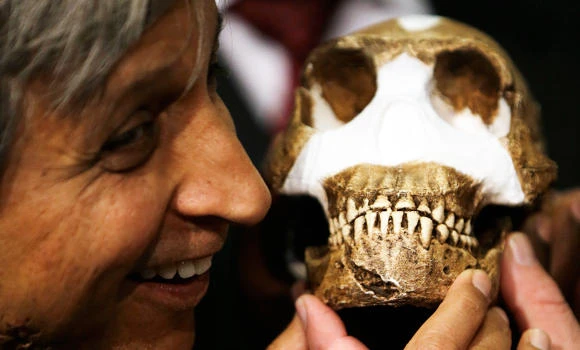
JOHANNESBURG: A dramatic fossil find has given South Africa reason to celebrate amid economic gloom, but some experts question its scientific significance.
By contrast, the political significance is not in doubt.
“We are delighted that discoveries that we would never have imagined have been found here,” said South African Deputy President Cyril Ramaphosa, who shared the stage with scientists last week during the televised announcement of “Homo naledi.”
The discovery, in a cave 50 kms northwest of Johannesburg, is Africa’s largest collection of hominin (human and human-related) fossils, 15 individuals pieced together from over 1,500 fragments.
Homo naledi, which has not been dated, has also stirred excitement because researchers say the hominids seemed to bury theirs dead - a trait previously thought to be uniquely human.
This has lifted sagging spirits in South Africa, whose economy shrank in the second quarter amid power outages and falling commodity prices.
“For a while at least, South Africa was the place where leading scientific research happens, not the vulnerable, emerging market economy,” the Business Day newspaper said in an editorial on Monday.
Some scientists say the conclusions are hasty.
“In science there is always a gap between the data you have and the interpretations you draw. And in the case of proclaiming a new species the gap is really large,” said Christoph Zollikofer of the University of Zurich.
Others say the fossils belong to an already-named species.
The University of California’s Tim White said from what he had seen, the fossils belonged to Homo erectus, a species discovered in the late 19th century.
“New species should not be created willy-nilly. In order to claim a new species one has to demonstrate that it’s different from anything that’s ever been known,” he said.
S. Africa basks in scientific glory