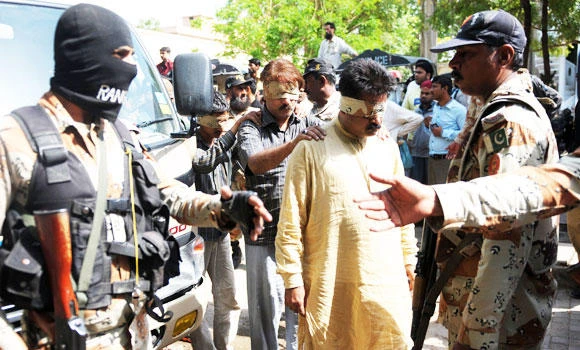
ISLAMABAD: A Pakistan court officials said on Tuesday that Saulat Mirza, a former MQM activist, would now be hanged on April 1. Mirza was sentenced to death for murdering the then-managing director of the city’s state-owned electricity company in 1997.
The execution was postponed for three days last Thursday after a video of Mirza emerged, claiming that Altaf Hussain — the chief of his Muttahida Qaumi Movement (MQM) — had ordered him to carry out killings.
The MQM maintains a strong grip on power in Karachi under the leadership of Hussain, who has been in self-imposed exile in London since 1992.
Also on Tuesday, Pakistan hanged a murderer as the interior minister confirmed a 30-day stay of execution for another man apparently condemned to death as a teenager.
Muhammad Nasrullah, who killed a man over a family dispute in 1994, was executed at a jail in the city of Multan in Punjab province, taking the number of executions to 55 since their resumption in December.
The hanging came hours before Interior Minister Chaudhry Nisar Ali Khan confirmed the execution of Shafqat Hussain would be delayed by 30 days.
Hussain’s case has attracted international attention as his lawyers and family claim he was only 15 at the time of the killing.
Khan said a committee would be set up to try to determine Hussain’s true age.
“We have not received any proof from anybody about his age, all the fuss is being made in the media,” Khan told reporters.
“We have to ensure justice not only for Shafqat but for the boy who was brutally killed and his body dumped in a Karachi river.”
Hussain, convicted of killing a seven-year-old boy in Karachi in 2004, was just hours away from the gallows when an initial delay was ordered last Wednesday.
Pakistan began a moratorium on capital punishment in 2008. It restored the punishment for terrorist crimes after Taleban militants last December gunned down 154 people, most of them children, at a school in the restive northwest.
Authorities earlier this month extended the penalty to cover all capital offenses.
The resumption of executions has caused anger among rights campaigners and some foreign powers, including the European Union and United Nations.
Saulat Mirza to be hanged on April 1