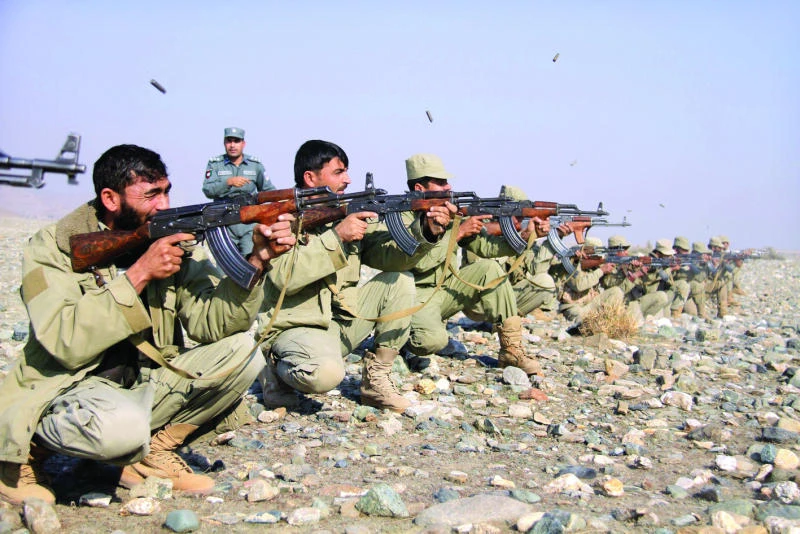
TACTICAL BASE GAMBERI, Afghanistan: US Army Major Eric Lightfoot, serving at a remote outpost in eastern Afghanistan, knows NATO has its work cut out to prepare local forces to go it alone against Taleban insurgents once its training mission ends in two years’ time.
Afghan President Ashraf Ghani said at the weekend the US, which provides the bulk of a scaled-down force of 13,000 foreign troops tasked with training local soldiers and police, might want to “re-examine” its deadline to withdraw by the end of 2016.
His remarks came days after NATO’s 13-year combat mission concluded, leaving Afghan security forces to lead the war on Taleban militants.
Lightfoot spends most days at this dusty base surrounded by mountains in Laghman province planning with Afghan army counterparts how they should use D-30 artillery, heavy weapons that should give the army a hefty advantage over insurgents.
Up until a few months ago, though, the Afghans weren’t using the 122-mm long-range weapon as intended, to hit targets several kilometres away, too far to be seen by those firing.
“They’ve been using it sort of like a tank, for direct fire at enemies they could see,” said Lightfoot, who has been helping Afghans to use the complex system of spotting and grids needed to hit targets further away.
“They’re getting better. They are having more successes,” Lightfoot added, citing the use of Afghan artillery in recent fierce combat in Kunar province near the eastern border with Pakistan, where army and police are fighting Taleban-linked militants.
But the reduced NATO mission requires painful choices.
Lightfoot said Afghan forces recently requested US air support in Kunar to dislodge insurgents, saying the enemy was in a position the Afghan artillery could not reach.
The US refused the request, and Lightfoot advised his counterpart to suggest that the D-30 be moved to another position where they could target the enemy.
“They are having to get used to standing on their own,” he said. “Come back in a few months, and we’ll see where they are.”
The number of NATO troops in the International Security Assistance Force in Afghanistan peaked at more than 130,000 in 2011 before a gradual drawdown began the following year.
According to ISAF, there were around 58,000 troops at the start of 2014 compared with some 13,000 now largely engaged in training.
Smaller NATO mission has big job to train Afghan Army in time