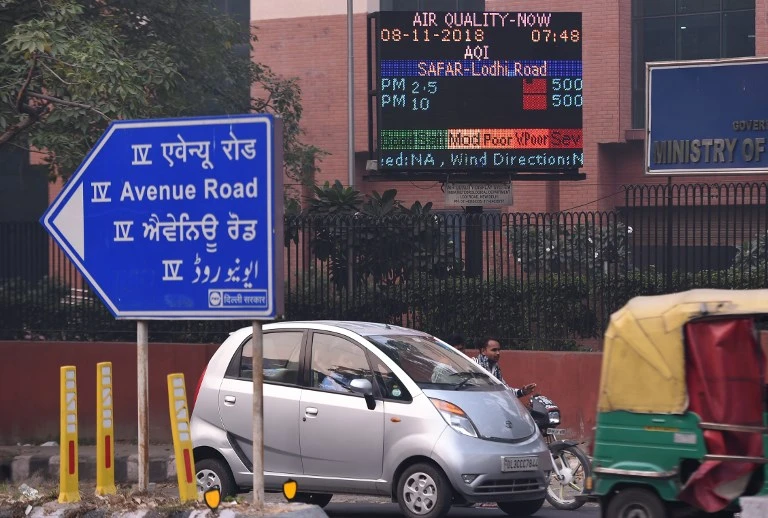
- Two of the federal government’s indices showed pollution levels at ‘very poor’ and ‘severe’
- These indices measure the concentration of tiny poisonous particulate matter
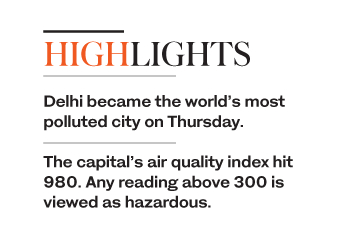
NEW DELHI: Fireworks celebrations marking the popular Hindu festival of Diwali lifted air pollution levels in New Delhi and surrounding areas to “hazardous” levels on Thursday. According to the website AirVisual, which monitors air pollution worldwide, the air quality index (AQI) reached 980 in the early hours of the morning, making India’s capital the most polluted city in the world.
An AQI below 50 is considered safe, while a reading above 300 is viewed as hazardous.
The Supreme Court had issued a ruling restricting the use of fireworks on Diwali night to two hours. However, many people defied the court order, with fireworks explosions leaving the capital blanketed in thick smog.
“It’s a matter of concern, but we hope that in time we will be able to bring the pollution levels down,” said Prasant Gargava of the Central Pollution Control Board (CPCB), a government agency working under the Ministry of Environment, Forest and Climate Change.
New Delhi residents and commuters, who are worst affected by the smog, rarely wear face masks, while many households still lack air purifiers. The lack of attention paid to toxic air stems partly from ignorance, apathy and crushing poverty, pollution activists say.
Government and local politicians have failed to effectively address the problem, according to social scientists and political analysts.
Polash Mukherjee, of the New Delhi-based Center of Science and Environment, told Arab News that “since Wednesday evening, air quality started deteriorating due to adverse weather conditions and excessive combustion. Fireworks celebrations worsened the situation.
“There are (some sections) of the government that are serious about addressing the pollution issue. The government, however, as a unit has not shown necessary commitment to tackle the problem.”
“Lack of social responsibility among people is also an issue. People talk about pollution, but at the same time keep on having three or four cars and violate the court and the government orders,” added Mukherjee.
V. Selvarajan, secretary of Green Circle, a group that campaigns on environmental issues, said: “Air pollution is a toxic mix of vehicle exhaust, smoke from burning crops from the neighboring states of Punjab and Haryana, and dust coming out of the thousands of construction sites. The pollution is intensified by winter weather patterns.”
He added: “Lifestyle changes are important for a solution. People in New Delhi believe in temporary solutions such as air filters, purifiers, instead of addressing the issue of air pollution which is mostly man-made. Car-pooling must be made mandatory.”
Meanwhile, daily life in the capital has been badly affected. Rahul Shukla, a jogger for many years, has stopped going outdoors. “The air quality affects your breathing and you feel restless while running. It is safer to be inside than outside,” he said.
Shukla, a lawyer, told Arab News that “if I don’t take care, my throat may bear the brunt of bad air quality and may affect my professional well-being.”
Dr. Bobby Bhalotra of the New Delhi-based Sir Gangaram Hospital said that “in recent days there has been a spike in cases of breathing problems, chest congestion and lung issues.”
The specialist in chest medicine said that “children are the worst sufferers. Their lungs are badly affected and this can have long-term implications, and might lead to cancer and other diseases.”