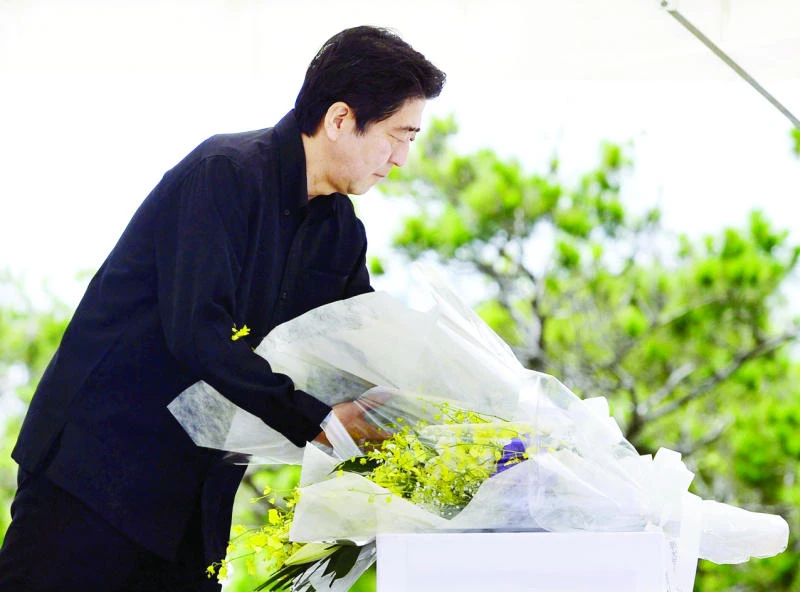
ITOMAN: Japan’s premier was heckled Tuesday at a ceremony to mark the 70th anniversary of the end of the Battle of Okinawa, the bloodiest episode in the Pacific War, as anger flared over the US military’s continuing presence.
In a highly-charged ceremony on Okinawa, Prime Minister Shinzo Abe was openly heckled by locals angry at the size of the United States’ presence on the subtropical islands.
Shouts of “Go home!” could be heard as the premier took the podium. It is relatively unusual for a Japanese prime minister to be jeered by the public.
Abe, who appeared rattled, told the audience Japan had for decades enjoyed the dividend of peace after the horrors of World War II.
“People in Okinawa have long been asked to carry a big burden for our security,” he said. “We will continue to do our best to reduce (it).”
Governor Takeshi Onaga was warmly applauded by the 5,000-strong crowd after using his speech to denounce “the heavy burden” of American bases in Okinawa, host to more than half of the 47,000 US service personnel in Japan.
“Seventy-three-point-eight percent of US military facitilites (in Japan) are still concentrated in our prefecture, which makes up only 0.6 percent of the country’s land area, he said.
The ceremony was taking place in Itoman, at the southern tip of Okinawa, near the spot where terrified locals had jumped from cliffs or were pushed to their deaths in June 1945 on the orders of Imperial Army soldiers taught never to surrender.
Thousands of visitors, many of them survivors of the war, filed past black marble monuments inscribed with the names of the fallen, to pray and leave flowers early Tuesday morning, amid tight security.
More than 100,000 Okinawans and 80,000 Japanese troops died in the 82-day battle for the strategically placed island chain.
Over 12,000 American soldiers also perished in what many had feared was a foretaste of the fight they would have to wage for the Japanese mainland.
That invasion never came, partly because of the atomic bombings of Hiroshima and Nagasaki, with a cowed Japan surrendering in August 1945. Okinawa was the only part of Japan in which battles were fought.
Entire families were wiped out, and almost everyone on the subtropical island lost at least one relative.
As well as those who committed suicide by plunging off cliffs rather than surrender, Americans found thousands more locals dead in caves where they had been hiding to escape the furious US bombardment, which came by air, land and sea.
Yoshiko Shimabukuro, 87, one of over 200 schoolgirls mobilised as a battlefield nursing unit for the Imperial Army in March 1945, said she felt remorse for surviving the war when so many of her friends died.
Tensions surface in Okinawa on 70th anniversary of battle