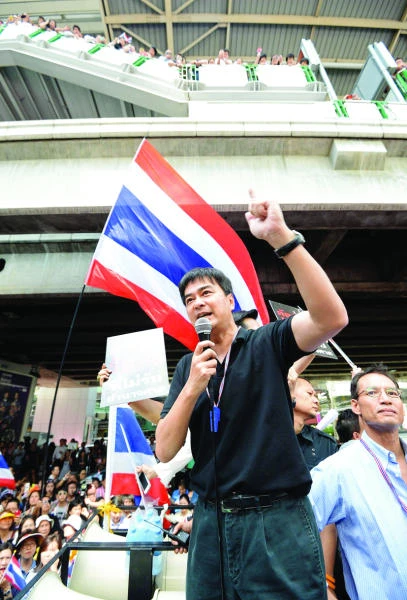
BANGKOK: Defiant Thai opposition protesters stormed the army headquarters and besieged Prime Minister Yingluck Shinawatra’s party offices on Friday, intensifying their fight to bring down her government.
Boisterous demonstrators have targeted key government buildings in Bangkok in the biggest street protests since mass rallies in 2010 degenerated into the kingdom’s worst civil strife in decades.
The protesters — a mix of royalists, southerners and the urban middle class sometimes numbering in their tens of thousands — are united by their loathing of former Premier Thaksin Shinawatra. The controversial former telecoms tycoon was ousted in a coup in 2006 and lives in self-imposed exile, but he is widely believed to be the real power behind the embattled government of his younger sister Yingluck.
Protesters are demanding the end of the “Thaksin regime” and want to replace the government with an unelected “people’s council.”
“The basic desire of the protesters and the protest leaders is to create chaos and destruction, presumably hoping that the military will have to intervene and take power from the government,” said Thailand expert Andrew Walker, a professor at Australian National University.
In the latest provocative move targeting a symbol of state power, demonstrators forced open the gates of the army headquarters in Bangkok, calling on the military to support their fight to bring down the government.
Flag-waving demonstrators massed on the lawn inside the army compound in Bangkok’s historic district for several hours before leaving voluntarily.
“We want to know whether the army will stand by the people not a dictator,” said a protest leader, Amorn Amornrattananont.
In a statement released hours later, army chief Prayuth Chan-O-Cha urged protesters to respect “the democratic process under the law.”
“Please do not try to make the army take sides,” he said, urging people to come together ahead of revered King Bhumibol Adulyadej’s birthday on Dec. 5.
The military has at times been a key player in the nation’s tumultuous political history.
The generals are traditionally seen as staunch defenders of the monarchy with close links to its supporters in the royalist “Yellow Shirt” protest movement — the arch-rivals of the pro-Thaksin “Red Shirts.”
But many experts believe the army does not want to become involved in the latest standoff — either in support of, or against, the government — for fear of a repeat of the 2010 bloodshed.
The military’s ties with the now-inactive Yellow Shirts also appear to have frayed, while the country is quietly bracing for the eventual end of ailing King Bhumibol’s more than six-decade reign.
Yingluck on Monday ordered special security measures to be expanded to cover all of the capital.
But she has ruled out using force against the demonstrators, who also massed Friday outside the headquarters of Yingluck’s Puea Thai party, setting up a tense standoff with riot police for several hours before protesters dispersed of their own accord.
With their spirits buoyed by free food and a party atmosphere, demonstrators have massed at several locations around the capital, occupying the finance ministry and blockading several others.
Their numbers have fallen sharply since an estimated crowd of up to 180,000 people joined an opposition rally on Sunday.
The carnival-like mood at the rallies masks deep divisions in Thai society that have erupted into political bloodshed on several occasions since Thaksin’s overthrow.
The protests snowballed after the ruling party tried to introduce an amnesty that could have allowed Thaksin’s return from self-imposed exile, and have continued despite the Senate’s rejection of the bill.