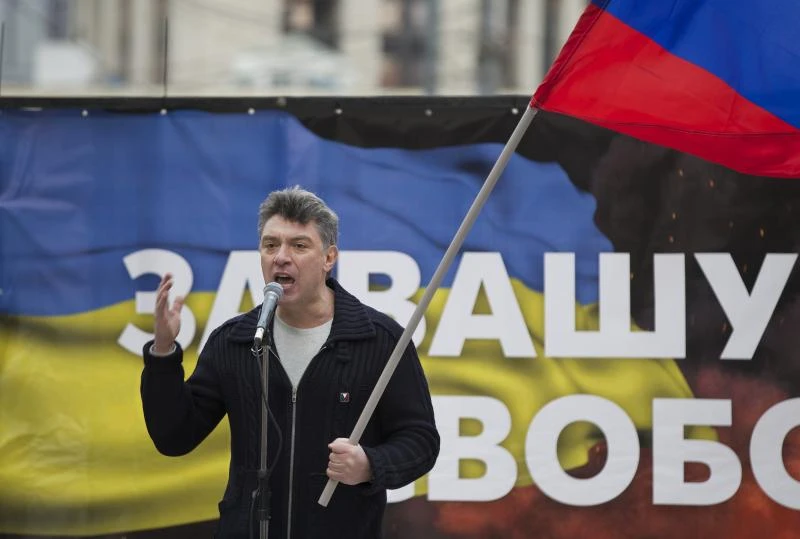
MOSCOW: Thousands of Russians prepared Sunday to march through central Moscow in memory of opposition leader Boris Nemtsov who was gunned down near the Kremlin in the highest-profile assassination of Vladimir Putin’s rule.
Friday’s murder of the 55-year-old former first deputy prime minister under Boris Yeltsin came ahead of a major opposition rally he had planned to lead. It plunged his shocked supporters into mourning, and prompted international condemnation led by US President Barack Obama.
Putin swiftly decried the brazen shooting as a “provocation” and in a condolences telegram to Nemtsov’s 87-year-old mother vowed to bring the perpetrators of “a vile and cynical murder” to justice.
Opposition activists scrapped plans to rally in southeast Moscow as authorities gave them rare permission to hold a 50,000-strong march to the bridge where Nemtsov was killed with four bullets to his back.
Shortly after the killing in sight of the Kremlin and the golden domes of Saint Basil’s Cathedral, both prominent and ordinary Russians flocked to the scene, now laden with heaps of flowers, photos and notes.
Investigators said the murder of the politician known for his criticism of Moscow’s involvement in Ukraine had been meticulously planned.
The Investigative Committee, which reports directly to Putin, said Nemtsov “might have been sacrificed” to sow instability, and they were also checking any links to the Ukraine conflict.
Opposition and liberal-minded Russians said that even if authorities were not involved in the murder, the Kremlin bore direct responsibility for whipping up anti-Western hysteria and hatred against dissenters which made the assassination possible.
Kremlin critics said the murder of the top opposition leader who had held senior government posts marked a watershed moment in politics.
“We have entered a new epoch — the epoch of the physical liquidation of political opponents of the regime,” prominent commentator Yulia Latynina said on radio.
“The message is absolutely clear: anyone who attends an opposition march can be killed. This is an act of political terror.”
The Russian president’s spokesman swiftly sought to allay fears.
“It would be too emotional and wrong to conclude that a string of such murders has begun,” Dmitry Peskov said in televised remarks.
Last weekend tens of thousands of Kremlin supporters including radical bikers and former soldiers were mobilized to demonstrate near the Kremlin walls, vowing to protect Putin from “Russia’s enemies.”
Another top opposition leader Alexei Navalny, who had planned the rally together with Nemtsov, said he was so shocked “that I am at a loss for words.”
Navalny, who has been jailed for two weeks in a move that prevents him from taking part in Sunday’s march, called on the authorities to allow him to bid farewell to his ally.
Hours before the killing, Nemtsov had gone on a popular radio station to urge people to join the Sunday opposition rally calling for “an immediate end to the war in Ukraine” and Putin’s resignation.
His death is the latest in a string of murders of opposition figures during Putin’s 15 years in power and brings to memory the shooting of anti-Kremlin reporter Anna Politkovskaya, gunned down on Putin’s birthday in October 2006.
Investigators said gunmen fired no fewer than seven shots from a car as Nemtsov reportedly walked with a woman, Ukrainian model Anna Duritskaya who was unhurt.
Footage aired by Russian television from a distant camera showed the suspected killer running along the road and jumping into a waiting car which then sped off.
The murder a stone’s throw away from the Kremlin — believed to be the country’s most thoroughly guarded locale — raised eyebrows, with many suggesting that the perpetrators were certain they would escape unpunished.
Navalny said he was certain the veteran politician would have been under surveillance ahead of the rally.
Nemtsov was a former physicist who became governor of the Nizhny Novgorod region in central Russia at 32 before serving in Yeltsin’s team.
After leaving parliament in 2003, he led several opposition parties.
A passionate orator with a ready smile and a mop of wavy black hair, Nemtsov was known for his zest for life and popularity with women.
He was a key speaker at opposition rallies against Putin’s return to the presidency in 2012 and authored a series of reports critical of corruption and misspending under Putin.
At the time of his death he was believed to be working on a study detailing the presence of Russian troops in Ukraine, a claim the Kremlin still denies.
Obama condemned the “vicious murder” of the politician he had met on a visit to Moscow.
British Prime Minister David Cameron said the “callous murder” must be investigated “rapidly and transparently,” while UN Secretary-General Ban Ki-moon said he “expects the perpetrators to be brought to justice swiftly.”
Ukrainian President Petro Poroshenko called Nemtsov a “bridge between Ukraine and Russia.”
“The murderers’ shot has destroyed it,” he said on Facebook.
Thousands to join march over slain opposition leader Nemtsov