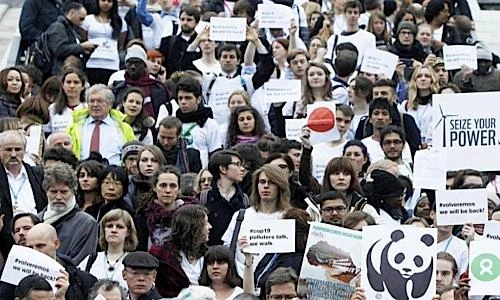
WARSAW: Rich and poor countries butted heads at UN climate talks in Warsaw with time running out on Friday to devise a plan to keep the troubled process on track.
Negotiators had worked late into the night, seeking consensus on how to forge an ambitious, global pact on climate change by 2015.
Yet nations remained deeply divided, said delegates.
They squabbled over how to share the burden of carbon emissions curbs to limit global warming to 2.0 degrees Celsius (3.6 Fahrenheit), and how to channel aid to poor countries.
"It is indeed one sleepless night in front of us but we are still hoping to close the meeting as soon as possible," said Polish Deputy Environment Minister Beata Jaczewska, whose country hosts the 11-day parley.
"I cannot give too many of the details but we are on a very good track," she insisted.
Gathering more than 190 nations, the annual negotiations are meant to pave the way to deal to be signed in Paris by December 2015 to tame climate-altering greenhouse gases emitted by burning coal, oil and gas.
The Climate Action Network, an umbrella body of green groups, said ministers still "have a lot to do" in Warsaw.
"Some emerging economies (are) blocking a way forward on a fair way to divide climate action, and still other delegations (are) fighting a solid agreement on when and where pledges" for emissions cuts should be made, it said.
On current emissions trends, scientists warn the Earth could face warming of 4.0 C or higher over pre-industrial levels, a recipe for catastrophic storms, droughts, floods and land-gobbling sea-level rise.
Developing countries want their wealthier counterparts to shoulder a bigger share of emissions cuts to account for a long history of fossil-fuel combustion.
The West, though, insists that emerging economies, voraciously burning coal to fuel their development, have to do their fair share.
China is now the world's biggest emitter of CO2, with India in fourth place after the United States and Europe.
Developing countries have accused rich nations of backtracking on their commitments.
They point to Japan for slashing its carbon goal, and Australia's decision to scrap a carbon tax on high emitters.
Time running out for troubled UN climate talks