TAIPEI: One of the engines on TransAsia Airways Flight 235 went idle 37 seconds after takeoff, and the pilots apparently shut off the other before making a vain attempt to restart it, Taiwan’s top aviation safety official said Friday.
Initial findings from the plane’s black boxes were released as reports emerged that the chief pilot was still clutching the joystick when his body was found in the cockpit, after he apparently battled to avoid populated areas. The details were presented at a news conference in Taipei by Aviation Safety Council Executive Director Thomas Wang as preliminary findings from the flight data recorder.
The Civil Aeronautics Administration (CAA) also disclosed that TransAir Airways had failed to meet around a third of the regulatory requirements imposed after another fatal crash just seven months ago in Taiwan’s western Penghu islands.
On Wednesday the French-made ATR 72-600 plane, equipped with two Pratt & Whitney turboprop engines, plummeted into a river after clipping an elevated road, as shown in dramatic dashcam footage.
In the first account of the last moments of Flight GE235, Taiwan’s Aviation Safety Council said the right engine had “flamed out” about two minutes after takeoff from an airport in northern Taipei.
Warning signals blared in the cockpit and the left engine was then shut down manually by the crew, for unknown reasons, the council’s director Thomas Wang told a news conference.
“The pilot tried to restart the engines but to no avail. That means that during the flight’s final moments, neither engine had any thrust,” he said. “We heard ‘Mayday’ at 10:54:35.” Wang said it was “not clear” why the left engine was shut down manually. “We are not reaching any judgement yet,” he said. But analysts said it was probable the crew made an error.
“It looks like they shut the wrong engine,” said Greg Waldron, the Singapore-based Asia managing editor at aviation industry publication Flightglobal.
“The right-side engine flamed out but that in itself is not enough to cause a crash because the ATR is designed to fly on one engine,” he noted. Gerry Soejatman, a Jakarta-based independent aviation analyst, said the Taiwan incident “could have been an innocent mistake.”
“What happened was that a few seconds after engine two flamed out, they (the pilots) cut the fuel to engine one, and when they cut fuel to engine one that’s when things started to go haywire because the plane was not powered anymore.”
Such a hypothesis recalls the 1989 crash of a British Midland Boeing 737-400, which came down on a motorway in central England when the pilots shut down a functioning engine instead of a defective one. Forty-seven people were killed.
“I will have to take a look again but changes in the layout of the engine instrumentation of the aircraft (compared with an older version of the ATR 72) could be a factor,” he said.
Wednesday’s crash into a river in Taipei minutes after takeoff killed at least 35 people and left eight missing. Fifteen people were rescued with injuries after the accident, which was captured in a dramatic dashboard camera video that showed the ATR 72 propjet banking steeply and scraping a highway overpass before it hurtled into the Keelung River.
Wang said the plane’s right engine triggered an alarm 37 seconds after takeoff. However, he said the data showed it had not shut down, or “flamed out” as the pilot told the control tower, but rather moved into idle mode, with no change in the oil pressure.
Then, 46 seconds later, the left engine was shut down, apparently by one of the pilots, so that neither engine was producing any power. A restart was attempted, but the plane crashed just 72 seconds later.
Wang said it was too early to draw firm conclusions about the reasons why the first engine ceased producing power.
“It’s only the third day so we can’t say too much,” Wang said. “We haven’t ruled anything out.”
It’s unclear why the second engine was shut down, since the plane was capable of flying with one engine. Several Internet aviation sites, including Flightradar24, questioned whether the pilots may have turned off the wrong engine in an attempt at a restart.
Taiwanese Vice President Wu Den-yih, mindful of the island’s reputation as a tourist destination and its tense relations with China where most of the flight’s passengers were from, went to a Taipei funeral parlor for prayer sessions to pay respects.
At the parlor, where bodies are being stored, Wu expressed condolences and praised pilot Liao Chien-chung, who died in the crash. The pilots may have deliberately steered the plane away from buildings and into the river in the final moments.
“When it came to when it was clear his life would end, (the pilot) meticulously grasped the flight operating system and in the final moments he still wanted to control the plane to avoid harming residents in the housing communities,” Wu said.
“To the plane’s crew, the victims ... I here express condolences.”
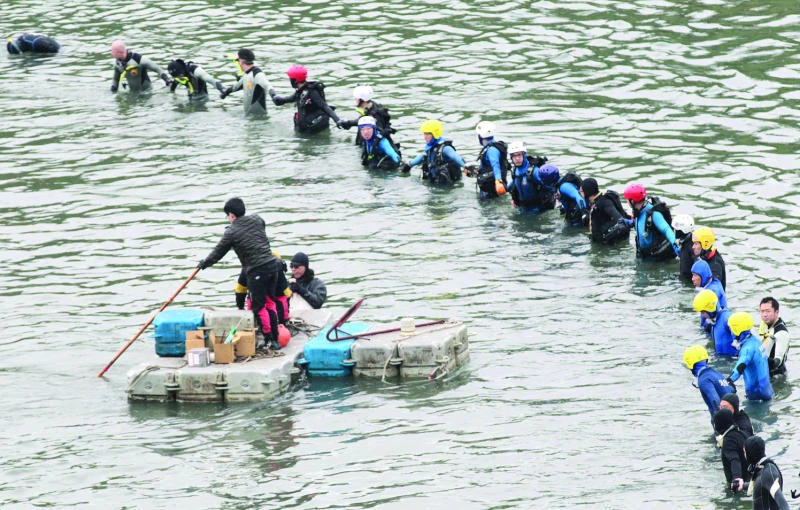
Divers with a local fire agency found one female and three male bodies Friday along the muddy Keelung River bottom about 50 meters (yards) from the crash site, a Taipei City Fire Department official surnamed Chen said.
The agency suspects the eight bodies that are still missing may be in equally murky areas and has sent 190 divers to look for them. Taiwan’s Ministry of National Defense dispatched three S-70C rescue helicopters to search along a river system that runs into the ocean off Taiwan’s northwest coast.
More than 30 relatives of victims cried wildly, prayed or were comforted by Buddhist volunteers at the riverside crash site as divers in black wetsuits brought back the four bodies. Some divers came ashore with their hands joined in prayer for the people they brought back.
TransAsia plane engines lost power before Taiwan crash