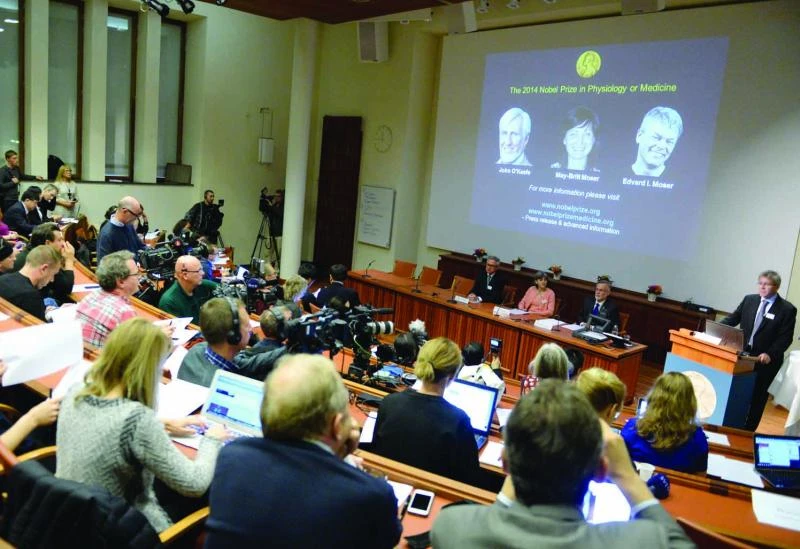
STOCKHOLM: British-American researcher John O’Keefe on Monday won the Nobel Medicine Prize with a Norwegian couple, May-Britt and Edvard Moser, for discovering an “inner GPS” that helps the brain navigate.
They earned the coveted prize for identifying brain cells enabling people to orient themselves in space, with implications for diseases such as Alzheimer’s, the jury said.
“The discoveries of John O’Keefe, May-Britt Moser and Edvard Moser have solved a problem that has occupied philosophers and scientists for centuries,” it said.
“How does the brain create a map of the space surrounding us and how can we navigate our way through a complex environment?” In 1971, O’Keefe discovered the first component of the system, finding that in lab rats, specific cells in the hippocampus were triggered when the animal was at a certain location in a room.
Other nerve cells were activated when the rat was at different places, leading O’Keefe to conclude these “place cells” formed a map of the room.
More than three decades later, in 2005, May-Britt and Edvard Moser found another piece of the invisible positioning system.
They identified “grid cells” — nerve cells, which generate a coordinate system, rather like longitude and latitude, and allow the brain to make precise positioning and pathfinding.
Research into grid cells may give insights into how memories are created — and explain why when we recall events, we so often have to picture the location in our minds.
The jury noted that sufferers of Alzheimer’s disease often lose their way and cannot recognize the environment.
A part of the brain where grid cells are located, called the entorhinal cortex, is closely linked to Alzheimer’s, said Torkel Klingberg, a professor of cognitive neuroscience and member of the Nobel Assembly.
“That’s one of the first places that are affected, so what these discoveries could lead to is the understanding of the symptoms in Alzheimer’s and other diseases,” he said.
May-Britt Moser told the Nobel Foundation that she was “in shock.” “We have the same vision, we love to understand and we do that by talking to each other, talking to other people and then try to address the questions we are interested in, the best way we can think of,” she said.
“And to be able to discuss this when you get an idea on the spot instead of (having to) plan a meeting in one or two or three weeks — that makes a huge difference.” Her husband was on a plane to Munich when the announcement came, TT news agency said.
He only learnt of the award when he stepped off the flight and was welcomed with flowers by airport officials — and discovered he had had “about 120 missed calls.” John O’Keefe told the Nobel Foundation that he was “hiding out” at home.
“It has been 43 years and at the beginning most people were quite skeptical with the idea that you could go deep inside the brain and find things which corresponded to aspects of the environment,” he said.
“Now the field has blossomed and I think the prize actually is as much for the field as myself and the Mosers.” The jury said the work had led to a “paradigm shift” in understanding how groups of specialized cells work together in the brain.
Trio win Nobel medicine prize for brain’s ‘GPS’