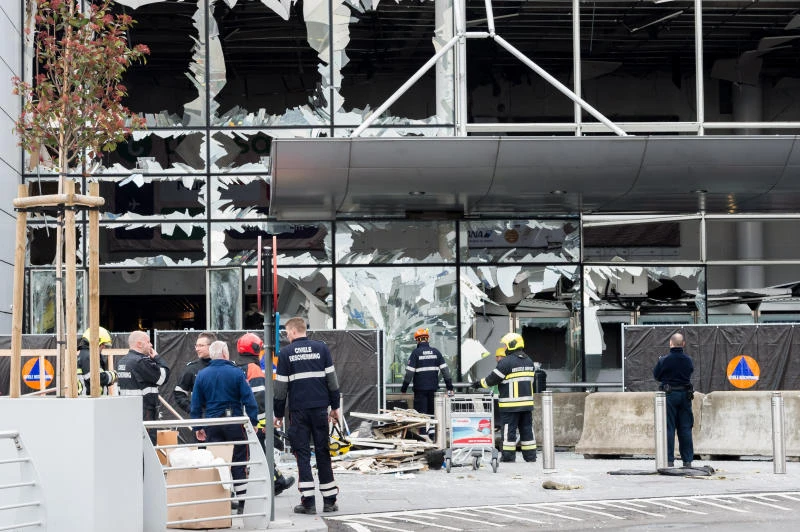
ANKARA, Turkey: One of the attackers in the Brussels suicide bombings was deported last year from Turkey, and Belgium subsequently ignored a warning that the man was a militant, Turkish President Tayyip Erdogan said on Wednesday.
Erdogan’s office later identified the man as Ibrahim El Bakraoui, one of the two brothers named by Belgium as responsible for the attacks that killed at least 31 people in Brussels on Tuesday and were claimed by the Daesh group.
Speaking at a news conference, Erdogan said Bakraoui was detained in the southern Turkish province of Gaziantep near the Syrian border and was later deported to the Netherlands. Turkey also notified Dutch authorities, Erdogan said.
“One of the attackers in Brussels is an individual we detained in Gaziantep in June 2015 and deported. We reported the deportation to the Belgian Embassy in Ankara on July 14, 2015, but he was later set free,” Erdogan said.
“Belgium ignored our warning that this person is a foreign fighter.”
Erdogan’s office confirmed that Bakraoui was deported to the Netherlands. It said he was later released by Belgian authorities as “no links with terrorism” were found. It was not clear when Bakraoui was handed over to Belgian authorities.
Erdogan initially said Bakraoui was deported in June but his office later said he was detained in June and deported in July.
The attacks in Brussels came just days after a suspected Daesh suicide bomber blew himself up in Istanbul’s most popular shopping district, killing three Israelis and an Iranian and wounding dozens more people.
Lack of will
Belgium’s has also come under fire elsewhere for its security failings, with France accusing Brussels of “naivety” over the spread of Islamist extremism in their country.
“I think there was... a lack of will, on the part of some (Belgian) authorities... perhaps also a kind of naivety,” French Finance Minister Michel Sapin said on Tuesday, suggesting they “thought that to encourage good integration, communities should be left to develop on their own.”
Speaking to French TV station LCI, he added: “We know... that this is not the right answer. When a neighborhood is in danger of becoming sectarian, we should (implement) a policy of integration.”
Among the more bizarre statements was that of Israeli Intelligence Minister Yisrael Katz.
But the timing of Sapin’s comments, just hours after the bombings at the Brussels airport and metro station, was considered highly inappropriate.
“It is indecent when people are suffering, are in shock. We need solidarity, not lectures,” said Belgian Socialist politician Laurette Onkelinx.
A member of Sapin’s own French Socialist party, Francois Lamy, described the finance minister’s statement as “just shameful.”
French Prime Minister Manuel Valls also sought to distance himself from his colleague’s words, saying he did not want “to lecture our Belgian friends.”
“We closed our eyes, everywhere in Europe and including France, to the rise of extremist Salafist ideas in neighborhoods where a mix of drug trafficking and radical Islam have led astray... some of the youth,” Valls told Europe 1 radio.
Nonetheless, Belgium has spawned more jihadists per capita than any other EU country, with some 500 leaving for Syria and Iraq from a population of only 11 million, officials say.
Its political divisions have prevented effective coordination between security services, and have also been blamed for allowing radicalization to fester.
A brief moment of elation followed the arrest of Paris suspect Salah Abdeslam last week in Brussels, but that was quickly snuffed out by Tuesday’s carnage.
In defense of Belgium
Despite all this, experts have warned against singling out Belgium for criticism.
“I’d caution against focusing too much on Belgium and blaming them,” said Thomas Hegghammer, a terrorism expert at the Norwegian Defense Research Establishment.
“This is about networks and where they are strong. Today, it happens to be in Belgium, but a similar situation could be replicated elsewhere,” he said.
Hegghammer noted that savvy militants were increasingly skilled at flying under the radar by using encrypted communications — and that this could happen in other countries.
Belgium’s ambassador to Britain, Guy Trouveroy, said it was “not entirely right” to suggest some areas of his country had been abandoned by the authorities.
“It is always easy afterwards to say ‘We should have, we should have’,” Trouveroy told the BBC.
“At the time, the threats were not there and this Syria issue is relatively new. We had to move up to the challenge and we went maybe pace-by-pace, haphazardly. It is not easy.
“These are professionals and they know how to put up commando operations.”
Turkey says Belgium ignored warning of terror attacks