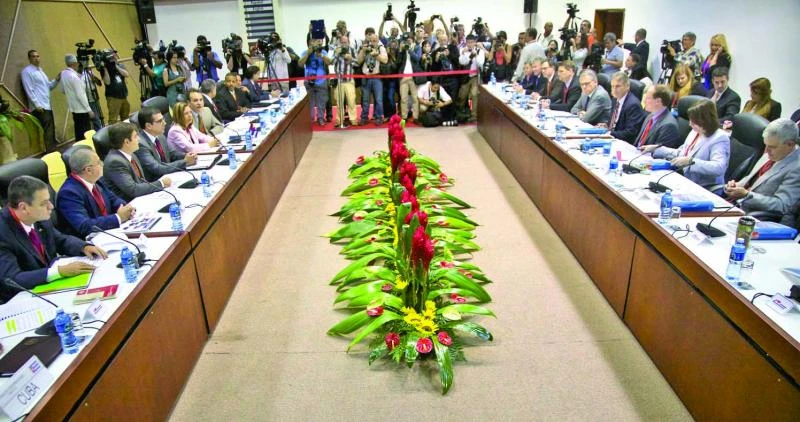
HAVANA: Cuban and US officials sit down Thursday for a second day of landmark talks in Havana aimed at reopening embassies and restoring ties frozen for decades.
The two sides claimed a good first day on Wednesday despite persistent disagreements over US migration policies, which communist-led Havana says encourages Cubans to flee to nearby Florida.
US assistant secretary of state Roberta Jacobson, the most senior US official to visit Cuba since 1980, will lead the American delegation for the second and last day of talks between the erstwhile Cold War rivals on Thursday.
Jacobson had a working dinner with her Cuban counterparts Wednesday evening.
US President Barack Obama and Cuban leader Raul Castro surprised the world in December when they simultaneously announced plans to normalize relations following months of secret negotiations.
The raising of the US and Cuban flags in each other’s capitals would send powerful signals of the new era the two nations want to enter, though no timeline has been given for the reopening of embassies.
On the eve of the talks, US Secretary of State John Kerry warned that the two sides still have much to negotiate before the longtime rivals can normalize ties frozen since 1961.
“When it is timely, when it is appropriate, I’ll look forward to traveling to Cuba in order to formally open an embassy and begin to move forward,” Kerry said in Washington.
Cuban officials have also downplayed expectations of major breakthroughs this week, stressing that normalizing ties was a long and complex process.
Cuba will be represented by the Foreign Ministry’s US affairs department, Josefina Vidal.
The two sides will negotiate how to turn their “interests sections” into fully functioning embassies with ambassadors in Washington and Havana.
The US mission to Cuba, a concrete and glass building along the capital’s picturesque seawall, has been a symbol of the countries’ animosity since it opened in 1977.
Across the main entrance, the Cuban government built a vast esplanade to hold anti-US rallies. In 2006, then President Fidel Castro ordered 138 flag polls erected to block political message the mission was emitting with a giant display screen.
Now, Washington wants Havana to reaccredit its diplomats; end travel restrictions for them within the island; ease shipments to the US mission; and lift a cap on US personnel.
For its part, the Cuban delegation voiced “deep concerns” over the situation of the interest section in Washington, saying the US embargo has left its consulate without banking services for almost a year.
Washington, Havana eye new embassies