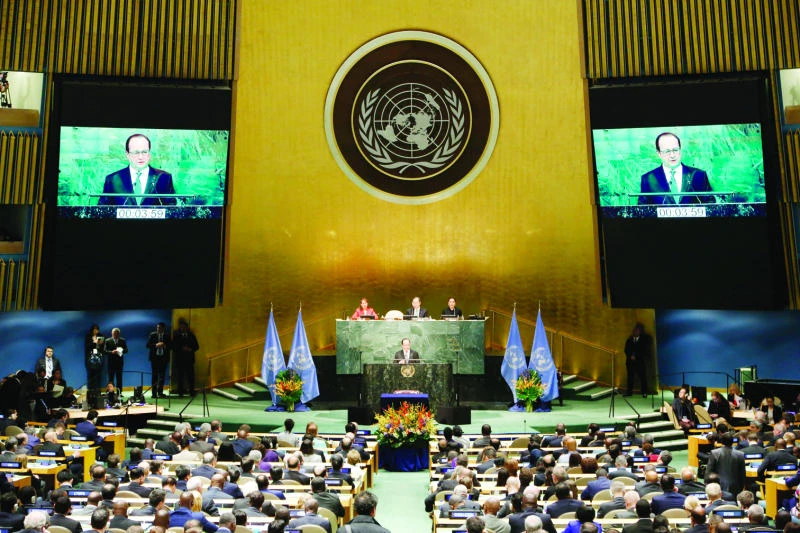
UNITED NATIONS: World leaders from 175 countries signed the historic Paris climate accord on Friday, using Earth Day as a backdrop for the ceremonial inking of a long-fought deal that aims to slow the rise of harmful greenhouse gases.
“We are in a race against time.” UN Secretary-General Ban Ki-moon told the gathering at the United Nations headquarters in New York. “The era of consumption without consequences is over.”
“The poor and most vulnerable must not suffer further from a problem they did not create,” Ban added.
“This is a moment in history,” he said while earlier announcing that 171 countries were set to sign the accord. “Today you are signing a new covenant with the future,” he said.
The landmark deal takes a key step toward entering into force years ahead of schedule. It sets a target of limiting global warming by 2100 to “well below” 2 degrees Celsius (3.6 degrees F), as compared to pre-industrial levels. To accomplish that, each nation sets its own target for reducing emissions and updates that mark each year.
Friday’s signing sets a record for the number of countries signing an agreement on the first available day, the Associated Press reported. The old record goes back to the Law of the Sea in Montego Bay, which was signed by 119 countries in 1982, according to AccuWeather.
Never have so many countries signed an agreement on the first available day. States that don’t sign Friday have a year to do so.
Many now expect the climate agreement to enter into force long before the original deadline of 2020. Some say it could happen this year.
After signing, countries must formally approve the Paris Agreement through their domestic procedures. The UN says at least 13 countries are expected to do that Friday by depositing their instruments of ratification.
The agreement will enter into force once 55 countries representing at least 55 percent of global emissions have formally joined it. The US and China, which together account for nearly 40 percent of global emissions, have said they intend to join this year.
“We definitely want to be in the first wave of ratifying countries,” Maros Sefcovic, the energy chief for another top emitter, the 28-nation European Union, told reporters.
The Paris Agreement, the world’s response to hotter temperatures, rising seas and other impacts of climate change, was reached in December as a major breakthrough in UN climate negotiations, which for years were slowed by disputes between rich and poor countries over who should do what.
Under the agreement, countries set their own targets for reducing emissions of carbon dioxide and other greenhouse gases. The targets are not legally binding, but countries must update them every five years.
“The signing could not come soon enough,” said Andrew Steer, president of the World Resources Institute. “Each month since the Paris agreement was reached has brought fresh evidence that Mother Nature has a fever and all life on Earth is suffering the consequences.”
The latest analysis by the Climate Interactive research group shows the Paris pledges put the world on track for 3.5 degrees C of warming. A separate analysis by Climate Action Tracker, a European group, projected warming of 2.7 degrees C.
Either way, scientists say the consequences could be catastrophic in some places, wiping out crops, flooding coastal areas and melting Arctic sea ice.
The United States is a key concern for the Paris Agreement as other countries worry what the next president might do. Analysts say that if the agreement enters into force before President Barack Obama leaves office in January, it would be more complicated for his successor to withdraw from the deal, because it would take four years to do so under the agreement’s rules.
“Walking away from the agreement would instantly turn the US from a leader to a defector” with serious diplomatic consequences, Elliot Diringer of the US-based Center for Climate and Energy Solutions think tank told reporters Thursday.
Held on Earth Day, the ceremony comes four months after the hard-won deal was clinched in Paris and marks the first step toward binding countries to the promises they made to cut greenhouse gas emissions.
While the US, China and India, the world’s top greenhouse gas emitters, were not be represented at their highest level, some 60 heads of state and government were set to be among the signatories.
The Paris agreement will come into force as soon as 55 countries responsible for 55 percent of the world’s greenhouse gases have ratified the accord.
The target date for the agreement to begin is 2020, but momentum is building to ensure the accord enters into force much earlier.
French President Francois Hollande called on governments to quickly ratify the Paris deal and singled out the European Union, saying the 28-nation bloc should “lead by example” and give final approval before the end of the year.
China and the United States have said they will ratify this year and are pushing for others to follow suit so that the agreement becomes operational possibly as early as late 2016 or 2017.
World leaders sign a historic climate ‘pact with the future’