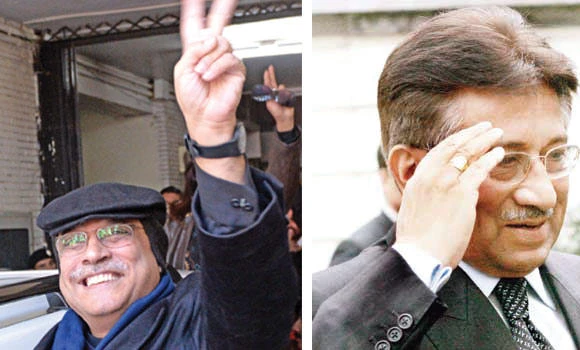
ISLAMABAD: Former Pakistani President Asif Ali Zardari appeared before an anti-corruption court on Thursday over multi-million-dollar graft allegations dating back to the 1990s.
In another development, a court trying Pakistan’s former military ruler Pervez Musharraf for treason Thursday ordered him to appear in person on Jan. 16, after considering a medical report on his heart complaint.
The cases against Zardari relate to kickbacks, money-laundering and the illegal construction of a polo ground at the prime minister’s official residence, during his slain wife Benazir Bhutto’s two stints as premier.
As president, Zardari enjoyed immunity from prosecution, but this ended when he stepped down in September last year after five years in office. After a brief session, the hearing was adjourned to Jan. 18. Defense lawyer Amjad Iqbal Qureshi told reporters the evidence against the former president was flimsy.
“He could not be indicted in the polo ground case because we argued that charges cannot be framed against him as there are no witnesses against him,” Qureshi said.
“We hope that he will be acquitted in this and other cases as well.”
Dozens of supporters of Zardari’s Pakistan People’s Party (PPP) greeted him at the court in a leafy residential area of Islamabad, chanting slogans and waving placards.
His appearance came as his predecessor as president, General Pervez Musharraf, faces trial for treason.
Another hearing was due in Musharraf’s case on Thursday but he has not yet appeared before the special tribunal due to security fears and ill-health.
Zardari’s aides were keen to contrast their man’s willingness to submit to the courts with what they see as the evasiveness of Musharraf, who many PPP supporters hold responsible for Bhutto’s assassination in 2007.
In Musharraf’s case, the ruling grants the 70-year-old, currently in a military hospital, a week’s respite in the case which has gripped the nuclear-armed nation for the past fortnight.
He has yet to appear in person before the specially-convened three-judge tribunal, missing hearings due to security fears and lately a health scare.
He was was rushed to the Armed Forces Institute of Cardiology (AFIC) in Rawalpindi, which borders Islamabad, on his way to the tribunal last week, and has remained there ever since.
After considering a medical report, which diagnosed the former commando with triple-vessel coronary artery disease, the court ordered Musharraf to appear on Jan. 16.
Another hearing is due in the case on Friday, when judges will consider certain procedural matters.
Thursday’s hearing came on the same day that Musharraf’s successor as president, Asif Ali Zardari, appeared before an anti-corruption court over graft allegations dating back to the 1990s.
Musharraf’s camp says the treason allegations, which relate to his imposition of emergency rule in November 2007, are politically motivated and his lawyers have challenged the authority of the tribunal.
His sudden health scare was met with scepticism by some observers, and rampant media speculation that his departure as part of a face-saving deal to avert a civil-military clash could be imminent.
Rumours have circulated for months that a backroom deal would be struck to whisk him overseas to avoid a destabilising clash between the government, which brought the charges, and the powerful armed forces.
But the former commando has said he wants to stay and fight the charges.
Aside from the treason allegations, Musharraf also faces trial over the assassination of former prime minister Benazir Bhutto, the death of a rebel leader, a deadly raid on a radical mosque and the detention of judges.
Zardari in court; Musharraf ordered to appear next week