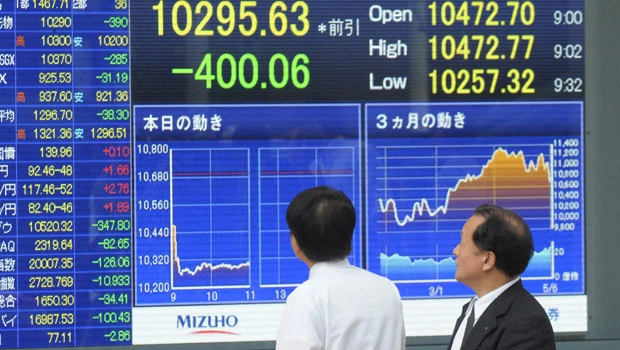
- JEDDAH: A global stock market rout gathered steam Friday as governments scrambled to shield the world from the Greek debt debacle and the United States launched a probe into a calamitous Wall Street plunge.
Virtually no part of the globe was spared Friday, with jittery investors bailing out of equities for safer instruments in Asia, Europe, Scandinavia, Russia and the United States.
A debt-and-deficit crisis that has engulfed Greece and is threatening the euro zone has now caught the attention of leaders farther afield.
The better-than-expected jobs figures, showing the US economy added 290,000 non-farm payroll jobs in April, gave only minimal support to risky assets. US stocks were trading lower and oil prices shed more than 2 percent.
Sterling hit a one-year low beneath $1.45 after elections in Britain left no party with an outright parliamentary majority, but it rebounded when Conservative Party leader David Cameron said he would try to form a minority government.
Reacting to the global stock market mayhem, Brad Bourland, chief economist at the Riyadh-based Jadwa Investment, said: "Two things are happening simultaneously. Markets are shaken by developments in Greece and Europe and economic data from the US shows the economic recovery continues to gain momentum."
US President Barack Obama said he and German Chancellor Angela Merkel had agreed on the need for a strong response from the international community.
"I made clear the United States supports these efforts and we'll continue to cooperate with European authorities and the IMF during this critical period," he said.
Finance ministers and central bank governors from the Group of Seven (G7) top industrialized economies also discussed the increasingly global crisis in a conference call, Dow Jones Newswires reported.
Earlier, Japanese Prime Minister Yukio Hatoyama said he was "very concerned" as stocks in Tokyo plunged 3.10 percent and Australian Prime Minister Kevin Rudd said he was watching developments in Greece with "considerable concern."
"The global economy is being tested once again and the violent and perplexing stock market sell-off on Thursday will bolster arguments that a heavier regulatory hand is needed to restore stability and confidence," John Sfakianakis, general manager and chief economist at Banque Saudi Fransi, Riyadh, said, adding what appears to be a trading anomaly gives fuel to lawmakers pushing for the biggest changes to Wall Street and bank regulation since the 1930s, and will increase public mistrust of financial markets.
The market was already under pressure because of the growing recognition that the crisis in Greece has gone from being a Greek problem to a regional problem, and now it's unfolding into a global problem. The crisis originated in Europe, and whatever happens in Europe will further inflate or deflate the global situation, he said.
The Europeans appear disorganized and unable to deal in a timely way with the Greek crisis and the recent statements from various European officials have been at best disconcerting to European unity. Europe is clearly suffering from a leadership crisis. Europe should learn a lesson from the Greek crisis and try to be more strongly supportive of Portugal and Spain as Europe has a long way to get out of this crisis, Sfakianakis added.
Contagion is very serious for Europe. Although the US does not look fiscally great either the fundamentals do look more promising given that non-farm payrolls came out very strong. The significance of this is that businesses seem to have entered an outright expansionary phase, especially in the US. Canada and Germany seem to be growing strongly as well. However, at some point markets could turn against the US as sovereign fears could become more serious and markets begin to price in the challenges there as well.
"An expected correction was bound to happen, given that equities have exhibited substantial gains and as de-leveraging will become more prescient, especially in emerging markets. There is though an exaggeration that the news is either too pessimistic or that optimism is always there. Growth in the global economy is happening but I wouldn't call it a boom, it's a recovery but the global economy is still fragile," Sfakianakis said.
In the wake of big losses on Thursday, all major European exchanges closed deep in negative territory Friday.
The London FTSE 100 index shed 2.62 percent to close at 5,123. 2 while in Paris CAC 40 fell 4.60 percent to finish at 3,392.59 points. The Frankfurt DAX lost 3.27 percent to end at 5,715. 9, Moscow markets plunged more than 5 percent and Nordic exchanges suffered losses of between 2.87 and 4.1 percent.
In early afternoon trading, the Dow fell 85.09, or 0.8 percent, to 10,435.23. It had been down as much as 279 in earlier trading, and at a few points recouped all its losses for the day before slipping again in the early afternoon.
The Standard and Poor's 500 index fell 10.23, or 0.9 percent, to 1,117.92, while the Nasdaq composite fell 37.34, or 1.6 percent, to 2,282.30.
On the currency market the euro managed to halt a dizzying plunge against the dollar, which took the single currency down to a more than 14-month low on Thursday of $1.2529.
The euro was trading at $1.27 against $1.26 late on Thursday in response to what analysts said were reports that euro zone ministers would take further measures to cut deficits this year and next.
Oil fell for the fourth day in a row on Friday and was on course to post its biggest weekly loss in almost a year and a half, tracking a steep fall on Wall Street on euro zone debt worries.
US crude oil futures were down $1.83, or 2.4 percent, at $75.28 a barrel by 1:30 p.m. EDT (1730 GMT), after falling further to $74.51, its lowest since Feb. 16.
Losses on the week already topped 12 percent, and would be the worst since prices fell almost 27 percent in the week to Dec. 19, 2008.
In London, Brent crude lost $1.70 at $78.13 on the ICE futures exchange.
— With input from agencies